Thursday, November 17, 2005

The English Language Debate Continues… (Part II)

I’ve written on the Part I of this post with regards to the arguments most often presented by the Chinese educationists in support of reverting back to teaching Science and Mathematics in the students’ mother tongue, particularly for Chinese vernacular schools. I’ve also presented my views with regards to why the arguments are not completely sound.

I’ve also been criticised by several readers (who, I must say, write really well) in some of my earlier post with regards to this topic, with a few who commented that due to the fact that I lack a background in Chinese education, I’m unable to understand the issues concerning Chinese vernacular education and that I’m biased against vernacular education. One of the readers have argued that:
Your supporting teaching Math/Science in English sounds a bit too much like rationalizing for the official lines. You appear to have stopped thinking rationally out of despise for a culture that you have not learned well.
So, I’ll spend the Part II of this post to give a quick reply to the criticisms I received above, as well as to present very simple straightforward arguments why the teaching of Science and Mathematics in English is beneficial to the students.

Firstly, my supporting the teaching of Mathematics and Science in English is indeed pretty much along the “official lines”. My only qualms with it are its implementation and execution, not its objectives. I don’t think there’s anything wrong with being part of the “official lines”, if the “official lines” are indeed the right thing to do. Irrationality comes in when one thinks that everything “official” is by definition, suspicious and wrong.

Secondly, I'll be the first to admit that my grasp of “Chinese” philosophy and culture is not at the level which I really wish I had. However, to say that I “despise the culture”, ooh… that’s just a little bit too harsh isn’t it? :) If you have read some of my other posts, I should hope that you’d be able to see and know that:
  • My mother tongue, i.e., the language which I communicate with my parents is Mandarin and nothing else.

  • My current lingua franca at home with my wife and daughter is Mandarin

  • I’ve written on the importance of the Chinese language

  • I wrote to my parents in Chinese while I was at university

  • I wrote to my wife-to-be in Chinese too regularly for 3 years while she was at university, after I have graduated :-)

  • As recent as last year, I took Chinese tuitioin classes to strengthen my Chinese technical and business skills to communicate with Chinese businessmen in China.

  • I took Confucian Studies (and aced it) for my ‘O’ Levels in Singapore.
I must have been torturing and despising myself for many many years, in fact, all my life, if I really “despised” the culture and language that much.

Both the Chinese and the English language (and even Bahasa Melayu) are extremely important, particularly for Malaysians who live in the Malay archipelago in between the modern English and the growing Chinese world. There is hence a need for balance. My arguments to continue the pursuit of the objectives of the policy are fairly straightforward.

“I not so agree(?)”

The standard of English among students originating from Chinese primary schools are extremely weak, often atrocious.

I know this purely from hiring some of the top students from the top local universities. These are students who scored more than 5-6 As for the SPM and achieved a cumulative grade point average (CGPA) of at least 3.3.

The “I not so agree” statement is just a direct transliteration from the Chinese statement “wo bu tai tong yi” (我不太同意). This statement is at least, understandable. There are many many other examples of emails and reports that I can cite, which unfortunately need to be heavily edited and re-written before I am able to submit them to clients. Feel free to study more examples here and here.

If these are the standards of the bulk of the top students from Chinese primary school background, then I cannot imagine the state of English language skills among the typical average (or poor) Chinese school students.

And the practical reasons why the English language is so darn important? Here’s just two for your consideration.
  1. The bulk of communication, written and verbal, done in large local and multinational companies in Malaysia, particularly in the higher management levels is undeniably, English.

  2. Barring a few exceptions, the top 50 universities in the world (using whichever rankings table), uses English as the language medium.
The Chinese educationists and their supports are just failing to see the magnitude of incompetence in the English language of the typical average Chinese school students. I see it because I actively recruit fresh graduates by reviewing plenty of resumes as well as conducting (too many) interviews.

As quoted by many readers, there are always going to be successful exceptions i.e., students who did well in vernacular Chinese schools, who were able to still switch and pick up new language skills successfully later in secondary and university education.

My wife, Ting Fong herself is proof of such exceptions. She did her 6 years of Chinese primary school education, 5 years of Sekolah Menengah Kebangsaan (SMK), 2 years of Junior College (JC) in Singapore, and 3 years of Law at Oxford. She literally 'aced' all her subjects (and puts me to shame). But she'll be the first to admit that she struggled badly during her first 3-6 months in Singapore with the language switch, and once again, the first 3 months at Oxford. In JC, she had her history essays literally thrown back to her unmarked because the tutor said he couldn't understand what she was writing - and she was the top English student (and the President of the English society) for some 10 years before that!

I for one, would never have had the opportunity to study at Oxford if I wasn't fortunate enough to have switch to a completely English medium in Singapore immediately after primary school (giving me, a slightly slower language learner more time to adapt).

But as highlighted, those like Ting Fong are exceptions. They have managed to do well despite the challenges they faced in the language. Many others who did well were fortunate enough to be based in large urban centres whereby the parents were already competent in English to aid their children. However, there are probably more than 80% (guesstimate) of Chinese school students who are not part of these exceptions, who should be provided with as much exposure to the English language as possible so that the opportunities for them in the future will be brighter both in terms of obtaining top quality further education as well as career advancement and prospects.

In this English language policy debate, we should appraise the system based not so much on what's good for the "Chinese schools", but what's best for the students and their future. In this respect, I'm happy that the Prime Minister has emphasised that the policy to teach Mathematics and Science in English is here to stay.

More Brickbats for Universiti Malaya

Yesterday, the Sun, who has been exemplary in the past week in highlighting the issues pertaining to the crisis faced by Universiti Malaya (UM), used for the first time in the print media, the word “idiotic” to describe the actions of UM administrators to date. Nik Nazmi Nik Ahmad wrote that
[t]he handling of the universities in dealing with this drop in rankings especially UM's administration can at best be described as confused, if not downright idiotic.
The Star also headlined an article “It’s no cause for jubilation”, quoting Deputy Minister of Higher Education, Fu Ah Kiow.

And in a most tactful and diplomatically damning comment on Universiti Malaya to date, Azmi Shahrom wrote on “How To Judge a Good University” in today’s copy of the Sun. What makes his assessment particularly meaningful, is that he is actually an Associate Professor and the Deputy Dean of the Law Faculty in Universiti Malaya.

Read the complete article in the Sun, for you won’t find another well-written commentary on university education which is able to make analogous comparisons to “sex” and “powerful kissing lips”! More seriously, he argued that:
Instead of strutting around like a bunch of peacocks, a sober examination of the ranking system and how it can help us improve should have been done. Now that UM is at 169, the same thing should be done instead of hthe hopelessly silly PR exercises of spin doctoring which has the appearance of the self same peacock waving its moulted feathers in desperation.
There has also been a few but noticeable criticisms with regards to this entire Universiti Malaya rankings crisis debate. They have argued that by focusing on the “rankings table”, we are missing the woods for the trees as if we were to take care of providing quality education, the rankings table will sort itself out. I agree.

However, the reason why the rankings table is so “important” in the discussions at this stage is that it provides a focus for the academics and education authorities to focus their attention on the state of higher education in Malaysia. The effect of the severe drop in rankings of UM have galvanised the public, the media and hopefully at the end of the day, the education and university authorities to take the necessary steps (even if they are baby steps for a start) towards reversing the decline in our university quality and reputation.

Without the initial debate on the rankings table, and the position of Malaysian universities in them, there would never have seen some of the discussions with regards to the setting up of “search committees” for university vice-chancellors, the public calls to improve the state of our universities, the set up of a parliamentary committee on education etc., as highlighted in my earlier post here. At some point down the road, the debate on the actual rankings table should cease to take prominence while the actual steps needed to transform our higher education system takes precedence.

The shift in debate is already taking place. Nik Nazmi commented on his Sun piece that:
But it is futile to dwell too much on the ranking issue, without seeing it in perspective: it's a symptom of deeper problems plaguing Malaysian higher education.

The major problems that we can see include the absence of genuine meritocracy; the lack of academic and political freedom in campuses; the prevalence of unemployment for many graduates; the poor command of English and a lack of focus in the direction of our education policy.
And today, Azmi Shahrom followed up with the extremely constructive piece of some of the critical actions that need to be taken to ensure the quality of our universities and their graduates are raised. Some of his criticisms, comments and suggestions include:

1. Transparency in Promotion
... make sure that good academics join and stay... make sure the working environment is conducive to research and those who are able to do good work are promoted. Good work here meaning publishable research by respected publishers and journals (not lifestyle magazines) and sound teaching; not administrative duties and brown nosing. This can be done quite simply by ensuring that the promotion process is open and transparent, for example by publishing the CVs of all successful candidates.
2. Foreign Faculty and Student Intake
Artificially enticing foreign students and lecturers will simply not work and in the long run will be disastrous for the institution. Artificial means would include lowering the standards so as to take in any Tom, Dick and Harry to study or work here; begging foreign universities to have student exchange programmes with us; or by paying huge amounts of money just to have foreign professors lend their name to our staff lists with little or no actual responsibility.
3. Quality of Graduates
The hard fact of the matter is that, by and large, our graduates do not have the sort of qualities that would make overseas employers want them, or do our graduates have the qualitites to go out beyond the coconut shell to offer their services to the world.

This is because Malaysian public universities treat students like children. Their freedom of speech is curtailed. Their freedom of assembly is controlled. Their freedom to vote is interfered with. Without such freedoms, students can't grow. ... they won't have the confidence, the chutzpah to grab the world by the throat and scream their arrival.
Coming from the Deputy Dean of the Law Faculty of University Malaya - who's clearly no buddy of the vice-chancellor, there's really nothing more I need to add. Go read his piece. And I hope those at the Ministry of Higher Education read it too.

Wednesday, November 16, 2005

The English Language Debate Continues… (Part I)

Two years after the policy to teach Science and Mathematics in English has been implemented, the great debate on the use of English language, particularly in the Chinese vernacular schools continue. Regular readers of this blog will know that I’ve commented at frequently on the issue, and I’ve attracted plenty of responses on my posts. The readers will also know that I’m pretty much in favour of the policy to continue the teaching of the two subjects in English.

Recently, the debate has heated up again with Dong JiaoZong (DJZ), the leading Chinese educationist organisation making frequent press statements, and the new Gerakan vice-president and Penang Chief Minister, Tan Sri Dr Koh Tsu Koon joining the fray of those seeking to abolish the English language policy. I’d assume that the debate typically heats up towards the end of every year due to the fact that it would be the opportune time for the policy to be revised to meet the new schooling year.

The arguments for the teaching of Science and Mathematics using the children’s mother tongue has not changed over the last few years. I’ve also received some fairly well written brickbats (which can occasionally be pretty harsh - more on this later) from readers with regards to my stand on the issue. These arguments include:


1. Better ability to grasp mathematical and science concepts in mother tongue
In a Star report, Tan Sri Dr Koh Tsu Koon was quoted arguing that
[i]t will be more effective if Science and Mathematics are taught in the mother tongue in primary schools… this allowed the pupils of different communities to understand the two subjects better if they were taught in a language they were accustomed to.
I actually do not disagree with the above argument at all. In the short term, students will definitely learn Science and Mathematics in their mother tongue. However, if we are always looking at things purely from the perspective of what’s “easier” and more convenient in the short term, then we’ll never be able to see the woods for the trees.

To quote Zainal Arifin in his Intermission commentary in the New Straits Times on the 9th November:
My answer to that is never underestimate the sponge-like ability of children to absorb new information, whatever language they come in. It is often adults, driven by adult agendas, who have trouble sleeping on it.
What I strongly believe is that once the initial teething issues have been ironed out, students will not have major issues coping with learning the two subjects in English. They are after all, still assisted with “translations” in their mother tongue. Take a very simple example across the border, the Chinese students in Singapore from the “heartlands” whose mother tongue remains Chinese, do not have any major issues or problems with learning Science and Mathematics in English at all!

2. That the policy does not at all help improve the competency in English
The other argument against the policy commonly used is that teaching the subjects in English does not assist the learning of the language. The authorities should instead increase the number of class periods allocated for the teaching of English language.

The argument that the number of periods to be allocated to teach English should be increased has merit. However, to claim that teaching the subjects in English do not help improve the competency of the language is totally out of place.

Once again, to quote Zainal:
The idea of teaching Science and Mathematics in English is rooted in the belief that, as for most things in life, we get better at something if we do it often enough. A prolonged exposure to English beyond the language class will make our children more comfortable with it, and help them develop an affinity for it.
There is only so much “Bahasa Inggeris” classes can help with one’s competency of the language. If the children are not exposed to the language regularly beyond the 2 (or 3 or 4) periods of English classes a week, they are never going to be fluent in the language. Exposure to other subjects such as Science and Mathematics in English will help the students gain additional familiarity with the language.

There are those who argue that the best way to pick up the language is really to “read and read some more”. And there have been plenty of instances cited on this blog by readers (e.g., here and here) who were able to ensure that their children are effectively bilingual (or even trilingual) through proper guidance and encouragement at home. I cannot agree more that these are probably the most effective ways to pick up the language.

However, we cannot forget that the likely majority of Chinese school students are not borne of English conversant families. My parents for example, barely knew twenty words of English combined. Without the additional exposure, the 2 periods of English classes a week are likely to be the only ever “sustained” exposure to the language for six years of their primary school life.

3. Preserving the character of vernacular schools
The third argument often cited is the fear that the English policy is an attempt by the Government to destroy the character of vernacular schools. I find such apprehension far fetched, as the policy is uniformly applied across national schools as well, much to the chagrin of Malay language nationalists.

The Chinese vernacular schools have not lost any of its character in the past 2 years of implementation, and I don’t see them as being any less “Chinese” than it was before. All the other subjects continue to be taught in Chinese language and the medium of communication in the schools are almost certainly Mandarin or other Chinese dialects.

Now, lets say, for the sake of argument, that the “character” of vernacular schools is indeed “altered” a little bit with the introduction of the English teaching policy. The question is, if it does works out to the benefit of the children and their future – why should we be so blinded by the absolute “preservation” of "character" to deny improved opportunities for the children?

To me, this third argument is the weakest of all the arguments put forth to review the language policy in Malaysian vernacular (and national) schools.

My personal issues with the teaching of Mathematics and Science in English have always been with its poor implementation and administration, not with its objectives. The “roll-out” of the system was too rushed and haphazard under the previous Education Minister, particularly with regards to the training received by the teachers, who had to conduct lessons in a language they themselves were not fully competent in. Some have also complained on the thickness and weight of the new biligual textbooks!

To me, if the objectives are noble and right, but the implementation was weak, we should work to improve delivery and not instead, throw out the objectives.

As for the brickbats I mentioned earlier, quite a few readers have commented that due to the fact that I lack a background in Chinese education, I’m unable to understand the issues concerning Chinese vernacular education and that I’m biased against vernacular education.

One posted that:
You don't understand what DongZong is doing because you don't read Chinese newspaper, I doubt you read any of the paper released by the organisation. Your source of information on this issue probably comes from English or Malay medium papers, which only tell you what they want you to know and think.
And another even argued that:
Your supporting teaching Math/Science in English sounds a bit too much like rationalizing for the official lines. You appear to have stopped thinking rationally out of despise for a culture that you have not learned well.
Ouch! Ouch! Ouch!

The Part II of this blog post will cover my (hopefully even-headed) response to such criticisms, as well as my personal simple argument why the teaching of Mathematics and Science in English is the right move for Malaysian children. And in case you think that I'm anti-whatsoever-Chinese, have a read at this earlier post first.

Tuesday, November 15, 2005

Universiti Malaya VC: Under Pressure, Unrepentent

Hey, I'm back after the brief internet-not-very-accessible break, and wow, plenty of things to blog about! :) My wife will be upset to hear this, but I "almost" wish I wasn't away, in a "happening" period like this. This is with reference to the state of our higher education system, epitomised by Universiti Malaya's love affair with the Times Higher Education Supplement (THES) world university rankings.

So what have I missed? I'll summarise them into the Good, the Bad and the Ugly, as well as give you a Low Down on what I personally think!


The Good

1. Deputy Higher Education Minister makes sensible statement

After making a silly and ill-informed statement immediately after the release of the THES world rankings table, our Deputy Minister of Higher Education has, probably after the increased media comment on the issue, released a statement which had the right messages. Sdr Fu Ah Kiow, as been quoted by Malaysiakini to say that
Universiti Malaya (UM) has no reason to 'celebrate' its ranking... since there is a drop from last year... The lower ranking of UM now is not something that we should be glad of... We will discuss the problem. We should take the ranking seriously. We should not be celebrating.

We should not be in a state of denial.
Yes, we should not be in a "state of denial" indeed!

2. Higher Education Minister gave 'positive' feedback

Our Parliamentary Opposition leader, Sdr Lim Kit Siang who has been at the forefront of pressing the need for a review of our higher education minister, has finally been granted an audience with our Minister of Higher Education, Datuk Shafie Salleh. The outcome of the meeting appears positive, with several developments expected over the coming weeks (months?). Most importantly, Datuk Shafie Salleh appears to have agreed to support the set up of a Parliamentary Select Committee on Higher Education.
Shafie agreed with the proposal for the establishment of a Parliamentary Select Committee on Higher Education to involve MPs to be active stakeholders in this critical area with far-reaching implications on the country’s international competitiveness, economic development and prosperity. He said he would raise the proposal in Cabinet.
In addition, it appears that the Minister have given word to the university authorities to remove the embarrassing billboards which juxtaposed pictures of the nation's leaders against the unabashed self-praise pronouncements. Datuk Shafie Salleh gave the cryptic reply of "Are the billboards still there?" when question by Sdr Lim. :) I can't wait.

3. The VC search committee

The Minister of Higher Education has also announced the likely set up of a "search committee" to select future vice-chancellors of Malaysian universities.

Interestingly enough, the Universiti Kebangsaan Malaysia (UKM) Vice Chancellor Prof Datuk Dr. Mohd Salleh Mohd Yasin’s response was most noteworthy when he commented:
Overseas, the appointment of vice chancellors are largely based on their leadership qualities as well as academic prowess. Now that we are practicing meritocracy, we should select the best candidate for the job.
There are probably still many practical issues to be resolved in the set up of such a selection committee, some of which were highlighted by Kian Ming here, but it's definitely an important baby step forward.

4. The is significantly increased awareness

I would like to think that the effort of the blogging community has not been in vain with regards to this issue, and I strongly believe that the mainstream press has caught up with the truth and details of the issue, thanks to readers and bloggers out there. In the past 4-5 days, there has been many articles (some of which I'm certain to have missed) appearing in both the English and Chinese press.

The Sun started on Wednesday last week with Citizen Nades asking if it's appropriate for UM to abuse the images of the nation's leaders. Oon Yeoh has put up his comment piece appearing in the Sun on Saturday, drawing from the findings arrived at this very blog. They've today, followed up with an editorial calling to "stop the rot... from the top".
If vice-chancellors are not good enough, if they serve political interests rather than academic ones, the battle is already lost. We need vice-chancellors who care, who are independent and are genuinely interested in improving academic standards.

If the VCs are not up to mark and are more interested in shamelessly promoting themselves and playing to the political gallery and political parties, then they should be replaced by those who can make a real contribution to the university. Here's where the first change should take place.
In another opinion piece published in the Malay Mail on Sunday, Vasanthi Ramachandran asked "how is UM going to pull itself out of its continual decline, when it refuses to accept or address the real issues and problems within the university?"
It is really scary when UM searches for irrelevant excuses to discredit the rankings table when it is not in their favour, and celebrate when it is.
And according to Jeff Ooi, who highlighted the issue twice over Saturday and Sunday, this blog was quoted in an article by Liu Jingwen of Oriental Times as well. (If someone could get me a copy of the article, whether hard or soft copy, that'll be great!)

There are of course many more blogs and letters published in the newspapers which have brought this issue to the forefront, making it unlikely to be easily brushed aside by those seeking to have the controversy brushed under the carpet.


The Bad


1. Parliament Rejects Debate on UM

The Sun highlighted that the Dewan Rakyat rejected an emergency motion tabled by Opposition Leader Lim Kit Siang to debate UM's fall in the worldwide rankings.
Speaker Tan Sri Ramli Ngah Talib said although the motion by virtue of
Standing Order 18(1) was specific in nature and of public importance, it was
not urgent.

Ramli said the steps to be taken include instituting peer review of UM, as
well as citation from other peer educational institutions. He also said the ministry had given an assurance that UM' teaching ratio would be improved, including the international
perception towards the university.
2. More "Praise" for the Vice Chancellor

Unsurprisingly, there was another letter appearing the Star, heaping more praise and accolades on University Malaya and its Vice-Chancellor. What I'm actually surprised is that there weren't more such letters! Interestingly enough, while the earlier letter of support was from UM's Dean of Engineering Faculty, this time round, it was just from a nameless "Concerned Academic Staff" of UM.

The "concerned academic" argued that the "drop in ranking was due to factors beyond UM's control".

One such factor was the fact that there was no foreign undergraduates in UM leading obviously to a poor "international student" score. This is true, but the "academic" forgets that this score only constitutes 5% of the overall score, and most universities which performed better than UM, had poor scores for this criteria anyway.

Another factor cited was the "employability of our graduates".
It is apparent that the employers interviewed for the survey are multinational companies. These companies select graduates from the western countries where they are headquartered. Such preferential treatment is beyond the control of the universities.
While I have my personal (serious) doubts on the methodology employed by THES in incorporating this new criteria, the argument put forth by "academic" is flawed. These multinational companies do not operate on the basis of "preferential treatment". They operate by hiring talents globally to ensure sustained growth and profitability of their organisations. The "academic" should take note that despite this apparent "bias", there are still 44 universities in Asia Pacific ranked above Universiti Malaya.

The following paragraphs from the letter is the most sadly laughable parts, only serving as new anecdotes to be added to my earlier post entitled "The Art of Flattery @ UM".
...the overall score in terms of total marks have improved by leaps and bounds if statistical interpretation is anything to go by.

The university's vice-chancellor and administrators have a gigantic task complying with government policies in the best interests of the nation as well as maintaining high academic standards for the campus. Walking this tightrope is a challenge and the vice-chancellor and administrators must be given due credit for their hard work in achieving these objectives simultaneously.

The vice-chancellor has done his best to create a conducive academic and research environment.

We like our vice-chancellor, especially for his academic competence, administrative leadership and, above all, his impartiality and rationality in performing his role. Due credit must be given to him for fostering a great team spirit among the different races and religions during his tenure.

The Ugly

The ugliest of what has happened over the last few days is strictly reserved for the UM Vice Chancellor, who remains absolutely unrepentent and recalcitrant.

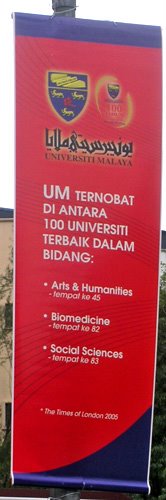
As highlight in plenty of blogs, as well as here, the VC has obviously found the funds and time to order a new set of some 150 buntings and banners to be hung all around the campus. He has obviously not learnt his lessons.

What's worse, the vice-chancellor has decided to print his own propaganda materials and flood the campus students and academics with them, in an apparent act to "justify" his position. Read all about it here @ Sdr Lim Kit Siang's blog.
...thousands or even tens of thousands of leaflets, 37 cm by 37 cm, flooded the campus, whether residential colleges or faculties, reproducing an article by Hashim in the local media extolling UM’s “achievements” in the THES World University Ranking 2005.

The Low Down

So what's the gut feel over the events of the past week? I'm actually feeling a tad optimistic, more optimistic than I was before my little break anyway.

Both the Minister of Higher Education and his deputy are now singing the same tune, and the right one too - that the crisis facing our higher education is not something to be swept under the carpet. Enough information has been provided and pressure has been applied to ensure that they are made aware of the truth of the circumstance, and not be easily satisfied or hoodwinked with explanations from the university administrators who have been too wily and economical with the truth.

Parliamentary Select Committees, for those familiar with political institutions and processes, are extremely important parts of the function of a assertive Parliament. One of the reasons for weaknesses in our local parliament, and hence its "rubber stamp" reputation, is not just in the overwhelming majority secured by Barisan National, but also in the (non)existence of secondary institutions within the Parliament. These secondary institutions will ensure greater contribution from Members of Parliament in the decision making process. It is not a step which will have dramatic effects overnight, but it's nevertheless an important step towards better governance, in this case, of our education system.

The response from the media, bloggers and public has been fantastic, quite beyond my own, and if I may speculate on his behalf, Kian Ming's expectations. The outright truth is being told, and I must say, some in the mainstream media are worded harsher than we have been. Needless to say, I believe that the spotlight we have all placed on Universiti Malaya and its vice-chancellor has resulted in plenty of pressure for the vice-chancellor, and for the education authorities to take the necessary actions. We definitely expect and hope that the furore to continue a little while more.

The actions of the vice-chancellor - new buntings, distribution of self written articles - are clearly that of a man forced into a corner, defending for his life in the academia. The fact that he has to focus on distributing propaganda within the university campus may just mean that he is perceiving or expecting a weakening of his authority and reputation even within the campus, and hence the need to "shore" it up. What else will he do?

I personally think that the VC has underestimated the backlash resulting from his actions and he is now in a position of no return for he has burnt his bridges. Had he been more intellectually honest with the entire exercise over the fall in world rankings as late as a week ago, he might have just about saved his seat. Unfortunately, I do think that his seat might just be too hot to handle today. We will see.

Monday, November 14, 2005

Attack of the Banners, Episode III


Again, I couldn't believe my eyes when I saw the pictures in Jeff Ooi's and Kit Siang's blogs. I thought that 'pasting' over last year's results were bad enough. This is going overboard. The UM VC must have worked his printers overtime to create these posters in a relatively short time. Maybe he should take out a few full page advertisements in the Star, the NST, Utusan and Berita Harian, publicizing the latest UM 'achievements'. How about using these posters as adverts on the KL buses as well as on the LRTs? Maybe even create an air ballon with these posters?

This only gives us more impetus to keep up the pressure on this guy who is obviously fighting for his survival and will resort to any and all short term tactics instead of planning for real reforms and improvement over the medium and long term.

Sunday, November 13, 2005

Vice-Chancellor's position mostly "administrative"? Think again

It saddens me greatly to read that our Minister of Higher Education, Dr. Shafie Salleh, has once again shown his ignorance of what higher education is about when he proclaimed that a VC need not be an academic because it is primarily an "administrative job". Such a remark shows that he's totally clueless about what is wrong with the state of higher education because a VC's job is much more than just an "administrative" job. As a leader of a research university, one of the VC's most important tasks is to promote the growth of academic excellence in his or her university. Only a person who has had extensive experience within the academic setting would know how to effectively accomplish this objective.

Perhaps Dr. Shafie Salleh should have examined the profile of the presidents or vice-chancellors of some of the better known universities in the world to see if they had an academic background or not for this "administrative" position. Let me list a few of them from the US:

Lawrence Summers - President of Harvard, PhD. in Economics, MIT
Richard Brodhead - President of Duke, PhD. in English, Yale
Shirley Tilghman- President of Princeton, PhD. in Molecular Biology, Temple
Robert Dynes -President of the University of California system, PhD. in Physics, McMaster University

All the aforementioned presidents not only have PhDs but are also or have been former (and some current) professors in their respective fields before taking up their current positions. They know the academic practice in terms of teaching and research because they have been through it and excelled in it as well.

No doubt there are some exceptions to the rule, like the recently appointed President of the University of North Carolina system, Erskine Bowles, former White House chief of staff to President Clinton, but these exceptions are exactly that, exceptions rather than the norm.

Let's look to the UK then.

Alison Richards - Vice-Chancellor of Cambridge, PhD. in Primate Biology, University of London
John Hood - Vice-Chancllor of Oxford, PhD. in Engineering, University of Auckland
Richard Sykes - Rector of Imperical College, PhD. in Biochemistry, Bristol University

Again, there are exceptions including Howard Davies, the director of one of my alma maters, LSE, who was the chairman of the Financial Services Authority in the UK before becoming director of the LSE.

But even the exceptions to the rule have been appointed because of their impressive CVs and vast experience in other fields which are definitely not "administrative", as our Minister puts it. They were appointed to lead their respective universities, not just "administer" them.

How about universities in our region?

Gavin Brown - Vice-Chancellor of Sydney University, PhD. in Mathematics, University of Newcastle-upon-Tyne.
Shih Choon Fong - President of National University of Singapore, PhD. in Engineering, Harvard
Mark Wainwright - Vice-Chancellor of the University of New South Wales, PhD. in Chemical Engineering, McMaster University

I didn't have the time to do this but I bet if you compile a database of the the past 10 presidents / vice-chancellors / rectors / directors of the top 100 universities in the world (using either the THES rankings or the Shanghai Jiaotong rankings), you would find that over 95% of them would have PhDs and would have had academic experience of one sort or another. I wonder if this fact has ever crossed the mind of our Minister of Higher Education?

His accusation of academic 'in-breeding' only applies if this person has been stuck in our local varsity system all his or her life. If one examines the profile of the VCs and Presidents of the top notch universities, one can easily find that most of them would have graduated from a good university, taught in another, and then become VCs or Presidents of their current university. Almost all of them would have impressive CVs and experience of an academic as well as non-academic nature. This surely can't be a sign of the 'in-breeding' that Shafie alleges. Or is he only pointing the finger at the current crop of VCs in Malaysia, specifically the VC of UM?

I have a suspicion that Shafie might have taken a look around and concluded that there might be a possibility that no well-qualified candidate can be found within the local university system for the VC job and that he might have to find someone from the private sector or from the government. Who knows, he might even want to appoint a politician to the post!

I sincerely hope that Shafie doesn't think that the VC's job is a purely "administrative" one in the narrowest sense of the word. A VC's job is multifacted and challenging from many aspects. He has got to push for excellence in academic and research standards, he has got to figure out ways to obtain sufficient funding to achieve these objectives, he has to oversee a recruiting process that will bring in the best and brightest brains to teach in his university and so on (I use 'he' in a generic sense lest I be accused of being sexist).But the fact that he thinks the VC position is merely an "administrative" one leaves me to wonder if he really knows what higher education is about. I've been trying to google him to find our where he got his PhD / medical degree from. Surely he must have gained some insight into higher education from where he got his graduate degree? Can someone help me find this out? Or his "Dr." an honorary title?

Friday, November 11, 2005

Foreigner as VC of local varsity?

Bernama, the NST and the Star all featured the announcement by the Minister of Higher Education, Shafie Salleh, that his ministry would set up a search committee in the appointment of future VCs in our local varsities. Looks like the pressure that has been generated online and offline have forced the ministry to respond, albeit in a rather limited way.

I want to pick up a point mentioned by Universiti Kebangsaan Malaysia (UKM) vice-chancellor Prof Datuk Dr Mohd Salleh Mohd Yasin.

“Overseas, the appointments of vice-chancellors are largely based on their leadership abilities as well as academic prowess. Now that we are practising meritocracy, we should select the best candidate for the job,” he said, citing the recent decision by the University of Manchester in Britain to select an Australian as its vice-chancellor.

It is interesting to note that it was blogged here that two other recently appointed VCs in Oxford and Cambridge also had foreign connections. One is a New Zealander (Oxford) and the other (Cambridge) is a British born academic who has spent much of her professional life in the US.

Should one of our local varsities, let's say UM, appoint a foreign VC? Or should we look inwards first for a suitably qualified local academic who has both academic prestige as well as administrative experience?

There will be a not insignificant number of people who would cry out for the appointment of a non-Malay to the VC position since no non-Malay currently occupies that post in any one of our local varsities. While I think that this would be a great symbolic gesture on the part of the government, I think there are substantive and practical reasons as to why this might not necessarily be a good idea. I also want to put forth some arguments on why I think a foreign VC might be in a better position to do a better job than a local. I know that my arguments will tick off many people but hey, that's what discussions are for, right? No point us agreeing to everything.

Firstly, I don't think that just because a non-Malay is picked means that he or she is the best person to do the job. If he or she is firmly entrenched as part of the 'system', it is equally unlikely that he or she will have the courage and desire to overhaul and reform the sad state that our local varsities are in right now.

Secondly, we have to acknowledge the reality that our local varsities operate in a predominantly Malay dominant environment. Any move to reform the system can be misinterpreted and misused as an attack by a non-Malay VC on Malay 'values' and 'sensitivities'. For example, a move to examine the tenure system in UM might lead to accusations that a non-Malay VC is trying to 'roll back' the gains of the NEP and reduce the number of Malay professors or associate professors. Unless we can operate in an environment where the race of the VC will not be used against him or her, I suspect that a non-Malay VC will have little chance of implementing real reform.

Of course, the retort might be that a non-Malay who has the respect of the Malay academics and staff in a place like the UM but who also has the desire to reform the system might be the best person for the VC position. Someone like Prof Khoo Khay Kim comes to mind. But academics like Prof Khoo are few and far between and they might be so far advanced in their career that a demanding, stressful and politically sensitive position like the VC would probably not interest them.

A foreign VC has the following advantages. He or she will come in presumably with a fresh mandate to shake things up, perhaps even a mandate coming from the PM. He or she would also presumably not be in it for the long haul but instead be signed to a shorter termed contract. This will provide the incentives for the foreign VC to leave a legacy and to accomplish the set out objectives sooner rather than later.

A foreign VC would also be able to bring in best practices from overseas and hopefully also experience from a renowned university. It is difficult for a local academic - Malay or non-Malay- who has been 'entrenched' in our local system to implement new things, especially things which he or she has never experienced before in a university setting.

We also have to recognize the reality that often, we instinctively 'trust' a foreign (read: Western) face more than a local face. While I don't agree with this mindset (since many Western professionals come to work in the East because they can't 'make it' in the developed countries), I cannot deny the fact that this foreign 'premium' so to speak, decreases the resistance to reform, especially if the foreigner is well qualified and knows what he or she is doing.

In addition, a foreign VC would not face accusations of the racial type. He or she might be accused of being insensitive to local 'culture', a realm which has got to be tread with care, but it is unlikely that he or she would have to fight fires the same way that a non-Malay VC might have to. Furthermore, as a foreigner, he or she will be given the benefit of the doubt, initially at least.

Finally, a foreign VC who's here for a short-term contract doesn't have to worry about 'pissing' people off the same way that a local would have to since the local presumably would want to have a career after stepping down as VC. If you want real reform, sometimes you need someone who is willing to take risks and shake the system up. A foreign VC who is well qualified, brings experience from abroad and who understands the mandate for change would arguably do a better job than a local VC.

Thursday, November 10, 2005

Consultant for USM?

It was recently reported that USM has engaged a consultant to report the reasons why USM dropped out of the THES rankings of the top 200 universities in the world. Tony has already blogged about it here and I want to add my two cents.

Is the hiring of this consultant really needed? For the sake of argument, let's give USM the benefit of the doubt. It might be a useful exercise for USM to confirm that the reason why they dropped out of the top 200 was because its international faculty and student scores were miscoded in the 2004 rankings. While Tony and I strongly believe that QuacquarelliSymonds Limited made the mistake of coding Indian and Chinese students and lecturers as foreign, we have not confirmed this. If USM gets this news from the horses' mouth, hopefully the VC would be more careful in the future in 'using' these rankings for self-promotion. And he might want to pass on the information to his fellow VC in KL. (We're assuming that the consultant hired by USM is indeed QS Limited)

But the report should go beyond this. If its worth the money that USM is paying them (and it cannot be peanuts), then QS should give USM a lengthy description and explanation of their methodology and hopefully the VC and his staff would come out of it a little bit wiser. For example, I would be interested to find out how the employer survey was conducted. Did QS send questionaires to local companies, regional companies or global MNCs? Did QS asked these companies to rank the quality of graduates coming out from universities only in their country or was the net spread wider? It wouldn't surprise me that surveys of this sort, which always has a cost constraint element, fail to have a sound enough or comprehensive enough methodology for some sections especially on a new score like employer rating.

The more important question is this - what is USM going to do with the consultant's report? It is very unlikely that it will make its content publicly available. More likely, USM will select and pick parts of the report that it can 'use' to its advantage. And if the USM VC is really smart, he'll be able to 'use' the report to try to 'boost' the ranking of USM for the following year. He can try to provide internal 'data' to QS Limited to be used in next year's ranking or he can try to find out who QS sends the peer review forms to so that he can try to 'influence' some of them.

Therein lies the danger. The report will be used not to introduce real and substantive change in university policies but to cover up the real and substantial shortcomings in the teaching and research standards in our local universities. I was hoping that perhaps, this report can be used by the VC to highlight the shortcomings within the system and in response, introduce real reform on the pretext of needing to be internationally competitive. But this is likely to be false hope.

Wednesday, November 09, 2005

Short Break

I'll be taking a short break with the family til the weekend's over. Internet access is likely to be intermittent, so you would be unlikely to hear from me in the next few days. But I'm certain Kian Ming will keep everyone entertained with more exciting write ups! Hopefully by the time I've returned, there'll be more good news to chat about. Have fun! :)

Tuesday, November 08, 2005

Universiti Sains Malaysia: Equally Clueless?

Most of the articles of discussion on the latest rankings table compiled by the Times Higher Education Supplement (THES) has been focused on Universiti Malaya (UM), partly due to the fact that UM has trumpeted its achievements louder last year as well as the fact that the vice-chancellor of UM appeared to have been more vocal in his denial of the state of affairs at the university. In addition, UM has always been the premier institution in Malaysia, hence such a steep fall in rankings from 89th to 169th was always going to be more controversial than other universities who never made it to the Top 200 list ever.

The only exception to the above is Universiti Sains Malaysia (USM) whose main campus is located in Penang. USM came in at position 111th in 2004 but disappeared altogether from the Top 200 in the current year's list. The only media comment I've read made by the vice-chancellor of USM on October 30th was highlighted in the earlier post.
USM Vice-Chancellor, Prof Datuk Dr Dzulkifli Abdul Razak was also interviewed by the Star, for the drop from 111th to "unranked". He hypothesized that "the addition of new criteria such as the employer survey could have contributed to the sharp drop in the university’s position."
As discussed many times on this blog, this argument is total nonsense. The real and only reason why USM was even in the Top 200 in the first place, is because the guys engaged by THES to compile the data, QS QuacquarelliSymmonds Limited, made a major boo boo with the USM data. Because QS were likely to have treated Chinese and Indian students as "foreign students", USM was ranked an incredible 4th most international university in the world. See blog post here for a more detailed explanation. As a result, the "size" of the foreign students contingent in USM results in a surprisingly respectable position of 111th in the world universities rankings table.

However, for some reason or other, which I find really really really difficult to believe, the academics and administrators at the university appears to be totally oblivious to the above factual reason behind the dramatic "fall" in rankings by USM. The figures and facts to arrive at the above conclusion are easily available, published by THES and do not require any complex mathematical calculations at all.

Why then, do I read today, that the USM Vice-Chancellor has chosen to engage "a London-based consultant to report on the reasons for USM being dropped from the list of the world's top 200 universities".
The consultant will submit its report at a meeting with USM administrators on Nov 21, said vice chancellor Prof Datuk Dzulkifli Abdul Razak.

He said the consultant was required to report in detail the criteria used by the newspaper to evaluate the top universities this year, after ranking USM at 111th spot last year.
If I'm not wrong, the "consultant" engaged by USM is the same party that conducted the above survey i.e., QS QuacquarelliSymmonds. This is because, the UM Vice Chancellor was quoted earlier to have stated that UM is also setting up a meeting with QS around the same time to "discover" the reason behind the fall in rankings as well as to better understand the methodology.

I wish USM will just pay me the consultant fees and I'll provide the reason(s) for the "fall" in rankings. I'll even give a big discount, saving Malaysian tax payers some valuable cash. Heck, I've published the analysis here for free already!

It is interesting also to find out what type of feedback QS will be giving UM and USM, since QS is the party contracted by THES to conduct the survey. Wouldn't there be some sort of conflict of interest if QS takes $$$ from the Malaysian universities?

And so what if UM and USM managed to better understand the methodologies behind the rankings table? Would both universities then decide to adapt and change the way to run the university in accordance to the table's ranking criteria just to improve the university's ranking? That just sounds a little too silly, right?

Wouldn't it be better for both universities to just focus on improving the quality of academics and facilities at the universities? The rankings will then naturally improve if our academics produces enough quality research valued by the peers and published regularly in respected journals. I just hope that the university administrators and the education authorities will get the priorities right!

Silver Lining in the Great UM Debate

For those seeking a silver lining in this entire debate and process triggered by dramatic decline in the ranking of Universiti Malaya (UM) in the World Universities Rankings table compiled by the Times Higher Education Supplement (THES) - "this" is it.

Since July and August, here in Education in Malaysia, we have put forth our views and opinions of the THES rankings, our consistent criticism of the university authorities in their celebration of their 2004 89th placement, our follow up and analysis of the 2005 rankings table, and lately, our disgust at the response of some of the university administrators to the steep decline in rankings. Jeff Ooi has blogged about it. Sdr Lim Kit Siang has written non-stop about it. I've seen many blogs which has linked or written to the issue since. And yesterday, Mack Zulkifli of BrandMalaysia.com has raised the subject and plugged this blog.

As a result of all of the above, the interest in the issue has been absolutely fantastic. Very much to our surprise, pageviews of this modest blog hit off the roof last week, despite being a public holiday week, hitting 6,800, more than double the prior week. Yesterday, thanks to Mack, the site registered more than 1,900 pageviews, a new high for Education in Malaysia.

The silver lining is not however, about hitting "new high" statistics. The silver lining is that we have had fairly open debate and discussions which have attracted many many readers and interested parties. Even the typically docile local press such as the Star have been publishing some critical comments on this issue. This, to a certain extent, is democracy and an increase in tolerance of critical discussions at work.

The outcome of the debate so far has put the vice-chancellor of Universiti Malaya on the defensive, and under pressure. The Star has even published a critical call by the Parliamentary Opposition leader for the Cabinet to publicly reprimand the vice-chancellor for his arrogant and indifferent attitude towards the severe drop in rankings.
Lim said the Cabinet should censure Prof Datuk Dr Hashim Yaacob for his public pronouncement that he was "not worried" and instead felt "great happiness" over the decline of the university's position in the international ranking.
The Minister of Higher Education himself has not been able to fully extricate himself from the UM debacle. It appears that he doesn't have the stomach to be critical of the vice-chancellor of his premier university for some reason or other. At the same time, it is noticeable that his "support" to date for the vice-chancellor has been lukewarm, with the only indication coming from his press interview with Bernama.
Shafie said that in terms of points, the results achieved by UM were still good but owing to the introduction of the positions and the inclusion of more universities in the ranking, its position slid.

"Performance-wise, the UM is still good but because the points between one university and the next are too close, even missing two or five points can result in a big drop in position," he added.

Will the Minister come to the Vice-Chancellor's rescue? Or wil they sink together?

This was just a regurgitation of what the vice-chancellor has earlier claimed to be the reasons behind the "improved performance". But it does appear that the minister is waiting for the issue to pan out or die a more silent death before making any further comments which may negatively implicate himself either way the issue pans out.

As responsible Malaysians, we really need to continue to raise the profile of this critical issue to address the decline in the standards of our public university over the years. We'd like to thank readers and bloggers alike to date for making this a high priority Malaysian issue.

To make sure that this issue is resolved favourably for Malaysians, we will continue to highlight it prominently in our blog and urge other Malaysian bloggers to do the same. For non-blogging readers, feel free to use the facts and figures which have been compiled on this site to write to the Star, the New Straits Times and the Sun. Not to forget, write to the MPs and ministers of your constituency and Barisan Nasional to express your concern over the leadership at our premier local university.

We hope that some time, one to two months from now, we will see more light at the end of the tunnel at least, for our higher education institutions.

Monday, November 07, 2005

Leadership Revamp Needed at UM

The University of Oxford and Cambridge in the UK are two well known and world class universities. Tony read PPE (Politics, Philosophy and Economics) at Oxford and I got my MPhil in Economics at Cambridge (after getting my BSc in Economics at LSE). It is hard to question the reputation of these two universities but yet these two universities have come under considerable pressure of the last 10 to 15 years.

Many of their best academics have been poached by leading US universities who can offer more research funding and higher salaries. By many accounts, among the academia, they have been overtaken by the top US universities in many fields and will continue to lose its competitive edge unless something drastic is done.

These two leading universities are hemmed in by a few things. “National service” is one of them since there is significant governmental pressure on Cambridge and Oxford to accept students from a wide variety of backgrounds (read: class). Funding pressure is another one since the maximum amount of school fees that they can charge their students is capped at a ridiculously low level (up to 3000 pounds in 2006) which isn’t anywhere near the cost of providing that education. In addition, because Cambridge and Oxford runs a college-based system of education at the undergraduate level, the cost of education per student is much higher than that of other public universities in the UK.

Both universities have in the recent past, appointed new vice-chancellors to meet these serious challenges. In 2004, Tony’s alma mater, Oxford, appointed Dr. John Hood - a New Zealander -to the VC position. His suggestions for reforms including subjecting academics’ work to closer scrutiny and linking pay to performance as well as introducing external trustees to oversee the governance of the university, has been met with disapproval from many of the Oxford academics. While one may argue against his methods or philosophy, it is clear that the senior leadership at Oxford recognizes the gravity of the situation and the need for reform if Oxford is to continue as a world class university.

Cambridge is watching this ‘experiment’ closely and if the reforms are successful, look for them to follow suit in the not too distant future. In the meantime, they appointed Professor Alison Richard to the position of vice-chancellor in 2003. While she was born in the UK, she has been in the US, specifically Yale, for the past 30 years, including 8 years as Provost (something like a chief academic officer).

Her mandate is not as controversial or extensive as that given to Dr. John Hood. It seems that she was brought back to Cambridge because of her fund-raising skills, an area in which the UK universities are mere amateurs compared to their US counterparts.

But make no bones about it, these two leading UK universities are more than aware of the pressures of international competition. Oxford has been the more daring of the two universities, indicated by their willingness to take on the ‘dons’ there – who some criticize are more interested in preserving and living in the ‘tradition’ that is Oxford rather than producing world class and cutting edge research.

The UM VC should take emulate at least the courage of Dr. John Hood by making real reforms - starting with improving the quality and accountability of the teaching staff – instead of patting himself on the back by erecting huge billboards promoting UM’s world class ‘recognition’. And the prime minister should give him the mandate to initiate these reforms and to see them through. If the UM VC cannot or is not willing to take this responsibility, his job should be given to somebody who will.

Sunday, November 06, 2005

More "Praise" for Universiti Malaya

Calvin & Hobbes is my favouritest comic. I have it's entire collection! And this panel "dugged" up by the Discordant Dude, portrays with the greatest understatement, the malaise in our higher education system.

Having written an earlier letter to highlight aspects of the quality of Universiti Malaya (UM) in the letters column earlier in the week, Prof Dr Mohamad Rom Tamjis has written another one, this time to the letters column of the Star Education pull out in praise of UM.

I commented on his earlier letter in the blog post - The Art of Flattery @ Universiti Malaya, and it appears that Prof Dr Mohamad Rom Tamjis will continue to provide "rock solid" support to his Vice Chancellor who promoted him to the Dean of the Engineering Faculty. While the previous letter was entitled "UM falls in ranking but is on right track", this one is entitled "Done well despite national demands".
Despite having to shoulder the duty of upholding the government’s policies and ensuring their successful implementation – which universities in other countries may not be subjected to – Universiti Malaya (UM) has performed very well in the international arena.
Let me see if I understood the above statement correctly. Is Prof Dr Mohamad Rom Tamjis alleging that "the duty" to uphold the government's policies comprised the standards at Universiti Malaya? Hence the reason why UM did not perform as well as "universities in other countries" as these other universities are not subjected to the same constraints? Interesting, we would definitely be interested in finding out what exactly are the government policies which are hindering the achievement of excellence at our local universities. These hindrances should definitely be voiced so that our universities will be able to achieve higher standards.
With regards to UM's world ranking this year at number 169 compared to 89 last year, it must be noted that this time, the evaluation criteria is more encompassing and comprehensive.
Errr... Prof, doesn't that mean that the previous year's ranking in which UM managed to squeeze into the Top 100 was an anomaly because the evaluation criteria is less "encompassing and comprehensive"? Why should we be happy about it?

And as expected, he ended the letter on a "high", asserting that UM should still be "congratulated". Interestingly, he also appealed for "concerned citizens" of the country to defend UM's image:
Only the best 200 universities are listed and UM is in the list... UM should be congratulated for its excellent performance at the international level. I hope that everybody, including those in UM, will continue to support the university to achieve a better performance in the future.

As UM is an icon of Malaysia, I feel that it is the duty of every concerned citizen of this country to defend its image and continue to support it for the good of our country.
Both Kian Ming and myself are extremely concerned citizens of Malaysia. It is because of our concerns which we feel that it's absolutely necessary to highlight the arrogance and malaise in the current administration of the university, which can only at some point in time, lead to further deterioration of standards at not only UM, but also other public universities in Malaysia.

We would argue that the manner in which both the vice chancellor of UM as well as Prof Dr Mohamad Rom Tamjis have been "defending" the image of the university have instead served to further heap dirt on Malaysia's premier institution of higher learning. Their statements have been dogmatic, arrogant, recalcitrant, constricted as well as analytically and intellectually unsound. We are providing constructive criticism to ensure that UM will not become a fallen icon of Malaysia, which will in effect make it's image indefensible except by parties whose sole interest is to "curry favour" the superiors.

School Fees Discrimination: Not Malaysian Enough!

It appears that, according to the Federal Territory education director, Noor Rezan Bapoo Hashim and the Deputy Director-General (Schools) Datuk Khusaini Hasbullah, our Education Act (1996) is discriminatory against certain Malaysians. For some Malaysians, possessing the same citizenship still results in different treatment, such as having additional administrative and approval processes and even possibly paying different fees for schools.

On October 22nd, it was reported in Malaysiakini that several parents from Jinjiang, Kuala Lumpur, are faced with the possibility that their children have to pay more for school fees because one of the parents is a foreigner. Their place in the school may also be in doubt as it is subject to approval from the Federal Territory Education department’s communication unit. This is despite the fact that these children are already Malaysian citizens on their own.

Parents were unsurprisingly “dumbfounded”.
"I don't understand. I am Malaysian. My wife is from Taiwan, but my 12-year-old child is Malaysian, has a Malaysian identity card (IC) and was born here. Is she still to be treated as a foreigner just because my wife is Taiwanese?" asked Ong Seng Eng.
Another parent, Lock Heng Chong, whose wife is from Thailand, said the school authorities themselves had certified his daughter's citizenship but he still had to fill up copies of the 'JPWP/HDS001' application forms entitled 'foreign students' application to enrol in state/ state-subsidised school. The officers in the school informed him that it was “new regulations” issued.

What’s even worse, was a case reported through a letter in the Star on October 31st whereby “M. M.” was required to re-register her child with the State Education Department although her husband and I are Malaysian citizens by birth!

The only possible reason for the “discrimination” was because the child was born overseas, registered at the Malaysian High Commission and issued with a Borang W within a year of her birth. At the same time she has carried a Malaysian passport all her life and has been enrolled in the government school system for the past nine years.
“Yet we were issued with triplicate pink forms entitled Permohonan Penerimaan Masuk Murid bukan warganegara Ke Sekolah Kerajaan/Bantuan Kerajaan and asked to provide duplicate certified copies of supporting documents.”
There has since been several versions of replies provided by the Ministry of Education officials to date. One official argued that the regulations were not new, but were just being “enforced” today.
"It's just that there has never been a comprehensive exercise to record such particulars since the law was put into place. The ministry just wants to find out how many children of permanent residents and other foreigners are enrolled in our public schools. We don't know, for example, how many undocumented migrants have their children enrolled in public schools. That's all this is, for record-keeping purposes."
This was perhaps confirmed via a report in the Star on October 30th which stated that:
Every school-going child with one or both parents who are non-Malaysians must register themselves with their respective state Education Departments before they are allowed to start school next year.

The new directive from the Education Ministry requiring such students to fill up a special form titled “entry forms for foreign children” is to facilitate its efforts to collect data on students and their parents’ citizenship status. Parents who have received letters informing them of this new requirement should go to the relevant state education department to fill out a pink form.
I can completely understand the ruling if it refers to children whose citizenship is not Malaysian, even though I am certain there are more efficient methods of administrating the process above. What I cannot understand is why should a Malaysian child, who by default, has the right to enjoy the national education system be put through such silly hassles and humiliation just so that the Ministry can collect some “data”? As far as I’m concerned, there are far less discriminating and discreet methods of collating the required data.

Datuk Khusaini Hasbullah attempted to appease the infuriated parents by assuring them that “the school will accept the child as long as one of his parents is a Malaysian citizen”. He rationalised that the parents were angry because of the name of the form which implied that their child was a foreigner. He suggested that his Ministry will rename the form “Entry Form of Children with One Non-Malaysian Parent”.

Datuk Khusaini Hasbullah completely misses the point. Why should the child, if Malaysian and possess relevant documentation, be required to complete a form and obtain approval from the Ministry of Education when he or she has no problems obtaining the national registration identity card as well as the Malaysian passport? Why not just revise the enrolment form for all students to incorporate these data requirements for the Ministry to collate the information as per the cited Education Act.

To quote “M. M.”:
While we appreciate that the Education Ministry needs to reconcile its students register/ database, the authorities could have handled the exercise with a little bit more logic and sensitivity and not assume that one cannot be a citizen just because he or she is born overseas.
What really humiliates the child as well as the parents, and rubs salts onto the wounds, is when an official clarified that the charges, RM 240 for the secondary school level, RM 120 for primary school pupils, would be levied on parents upon approval of their application forms.
"The approving body is at the ministry level, not here at the department, and definitely not at the school. Furthermore, there's no question of payment at this moment. That only comes into the picture if the approval has already been made at the ministry.
Once again, this official completely misses the point. The contention is not so much “when” the parents have to pay the extra fees, but a “why” should their child, who is a Malaysian, have to pay more fees than other “normal” Malaysian children?

Noor Rezan Bapoo Hashim explained that one of the clauses under the Education Act states that as long as one of the child’s parents is a foreign national, the parents must fill the additional form. “Based on that, we can check whether these children have to pay more fees,” she said.

At the same time, the Education Ministry financial division secretary Mahanum Abdullah said that the move was to ensure that foreign students settled their fees promptly as many had failed to do so.

No, Pn Noor and En Mahanum, the way to check whether the child have to pay additional fees is not by checking for the nationality of the parents. It is by checking the nationality of the child!

Pn Noor had the cheek to advise parents to go ahead and register their children early “as sometimes these forms take time to process and I don’t want them to miss out on the first few weeks of term.” Pn Noor, if your department or ministry is unable to cope with the administrative and paper work involved in the policies to be implemented, then please don’t create these unnecessary rules and regulations in the first place!

I am certain that the above administrative debacle is not due to national laws and regulations such as the Education Act. The spirit of the law is clear, in the simple sense that foreign students need to be properly identified and registered. However, the civil service interpretation of such laws tend to be overwhelmingly to the letter and form, even if it is impractical, inefficient and worse, diametrically opposed to the spirit of the law.

We have obviously too many civil servants in the government, for the director-generals could no longer find productive functions for them to perform. Instead they have to be occupied with strategising on a "new entry registration for children with one non-Malaysian parent" and implementing new administrative red tape, paperwork and absolutely unnecessary hassles for the rakyat.

As expected, the Minister of Education Datuk Hishammuddin Hussein, when queried by the MP for Kepong, Dr Tan Seng Giaw in Parliament more than a week ago, had no answers. I don't expect the minister to have answers probably because he is unaware that his ministry officials are so capable of ingenius ways of inconveniencing the public. Hopefully, he doesn't take too long to rectify the silliness of these new procedures and provide his response to Malaysians accordingly.

Saturday, November 05, 2005

More foreign students in UM? Part II

Bernama reported yesterday that the Minister of Higher Education, Shafie Salleh, will give 'greater focus' to the 'internationalization' of UM as a strategy to promote its international reputation. He's starting cautiously by only mentioning mentioning the recruitment of more foreigners at the post-graduate level. This is in contrast to what the VC was reported to have said earlier which was to open up 5% of places at the undergraduate level to foreigners. Shafie is wise to start at the post-graduate level since opening up places to foreigners at the undergraduate level will open up a huge can of worms and stir up great controversy.

Let me start of with some positives since we've been bashing the VC as well as Shafie quite a bit over the past week or so. In the same Bernama report, Shafie said that 5 local universities will be having joint PhD programmes with Imperial College (IC) of London starting next year. If this indeed materializes, I think it would be an excellent opportunity for our local varsities. Firstly, it would reduce the cost of obtaining a 'foreign' PhD since Malaysian students would not have to stay in London for any extended period of time and PhD school fees would presumably be much lower as well. Secondly, in a related point, the reduction in cost might allow more lecturers who are currently waiting to be sent abroad to do their PhDs, an opportunity to cut short that waiting period. Thirdly, Malaysian PhD students would be able to learn and benefit from the expertise of professors at IC, one of the top engineering schools in the UK, if not worldwide.

But the devil is in the detail. There's an old saying which goes something like 'Beware of Greek bearing gifts'. One has to examine what IC is getting out of this. There's no such thing as a free lunch and if this partnership is realized, one must see that it ends up being a win-win situation for both parties and not just the Malaysian government dishing out tons of money to IC for this partnership. One must also ensure that Malaysians who go through these PhD program actually get sufficient contact time with IC professors and not just have email contact or see them once or twice during the course of a year. Finally, one hopes that this partnership will actually result in a revamp and improvement in the training that a Malaysian PhD student gets and not just be a purely symbolic gesture.

Having this kind of partnership with foreign universities might be a strategic way of overcoming the lack of suitably qualified professors in our local universities. One would of course prefer that this shortcoming be overcome by better qualified locals but this is at least a short term measure to stop the bleeding.

Shafie is also wise in saying that it would be unwise to recruit too many foreign students at the taxpayer's expense. I am sure that many of use would prefer to see the taxpayer's funds put to uses which can more directly increase the quality of our universities like paying qualified lecturers a more competitive salary or better infrastructure for science labs and the like.

Many state universities in the US who have experienced cuts in their education budget that is funded by the state has also cut funding to PhD students, especially foreigners. I'm lucky because I'm in a private university that is very well-endowed. In the UK, most PhD programs do not offer scholarships to foreigners and many in fact charge foreign PhD students, especially those that are funded by their home governments.

Now, for the question marks. Shafie mentioned that he would ask the governments of Australia and New Zealand to encourage their students to "participate in credit transfer programmes with Malaysian universities such as UM". What makes Shafie think that Australian post-graduate students would want to have part of their post-graduate training in a local university in Malaysia especially when the expertise in Australia is so much better across the board? I can think of a few exceptions - in areas where local varsities have professors who have expert knowledge in the field that cannot be found in Australia or in areas which Malaysia has a comparative advantage in (study of tropical diseases, study of ethnic politics). But these are likely to be niche areas. If Shafie thinks he can market Malaysian universities to post-grad students in Australia, then kudos to him.

Unlike the IC arrangement, where IC post grad students are not expected to come to UM to get credits (at least to my understanding), this seems like another hare-brained idea with little chance of success (short of throwing money at Australian graduate students).

One of the key elements of a good PhD program is to have professors who excel in research. This is what distinguishes a research university, which UM is supposed to be, from a teaching university. Having more foreign post-graduates will not drastically improve a university's research or PhD program if the same professors are in charge of those programs.

If Shafie wants to develop UM into a research university in the long term, he should come up with a comprehensive plans which (1) gives incentives to professors to conduct research and to punish those who don't (2) provide avenues for professors to bid for competitive funding sources. The other stuff is just window-dressing.