In a report last Saturday in the Star, our Minister of Higher Education Shafie Salleh, announced that 5% of the places in our local public universities will be opened to foreign students. At the end of that article, I noticed Shafie giving an interesting statistic - that only 29.7% of lecturers have PhDs, against the target of 70% which the government has set. I assume that Shafie is referring to lecturers in public universities although that wasn't explicitly stated.
This statistic surprised me greatly. My sense has always been that the % of lecturers in the local universities with PhDs is closer to 50% than 30%. Perhaps my impressions have been based on my interactions with faculty in UM, USM and UKM. It might still be true that the % of lecturers in UM, USM and UKM is substantially higher than 30%. But irregardless, this statistic is shocking. How can we expect to have world class universities if only 30% of our lecturers have PhDs? It would be impossible for someone to lecture at a half-decent university in the US or the UK without a PhD qualification. But this seems to be the norm rather than the exception in Malaysia.
Granted, Malaysia has a unique system whereby lecturers without PhDs are required to teach in local universities before being sent abroad to get their PhDs. But still, wouldn't one expect this policy, after time, to increase the % of our lecturers with PhDs? My impression is that a university like NUS is drastically ramping up the % of its faculty with PhDs. I won't be surprised if it reaches 100% by 2010. In contrast, our Minister of Higher Education, in the same Star report mentioned above, that we'd have difficulty even reaching the 70% target. Perhaps, our UM VC and our Minister can ask Prof Shih, the president of NUS, for advice on how to achieve this 70% target.
But in the meantime, I'd like to offer up my 2 cents worth of advice based partly on my own experience and what I've heard from my friends in Malaysian academia. Firstly, encourage those lecturers without PhDs to apply for private sources of funding to do their PhDs. One of the major impediments to those lecturers who want to go abroad to do their PhDs is the lack of government funding. This is not surprising given that the government pays for both the school fees as well as the living expenses of lecturers who go abroad to do their PhDs. In a good school in the US, this would probably cost 45,000 US$ per year ($30,000 for school fees and $15,000 for living expenses). Hence, there are only a limited number of places available in a year, which explains why some lecturers have to wait 10 years or more before being sent to do their PhDs abroad (if at all).
The system does not give incentives for aspiring PhD candidates to seek external private funding. The length of the bond is the same regardless of the amount of the government scholarship. And if one wants to apply for external scholarships such as the Fulbright (US) and the Chevening (UK), one has to go through a government body such as the JPA to apply rather than apply directly. Furthermore, most local universities only provide funding for 3 years which encourages potential candidates to apply to universities in Australia and the UK rather than the US, where private funding is more readily available. In my case, I obtained a school fee waiver ($30,000 per year) plus a yearly stipend from my university (guaranteed for 5 years), Duke, as well as summer funding from a Fulbright scholarship. It is common practice that if you are accepted into a good PhD program in the US, your school fees will be waived and you are likely to receive some form of yearly stipend. You'd be lucky to get your school fees waived in a UK university. Living costs support is almost unheard of.
Wouldn't it be easier for our local universities to create a system which encourages aspiring candidates to seek private funding as a way to overcome the local shortage of funds? Doesn't it make sense to create a system which decreases the length of the bond for candidates who manage to find outside funding?
The current system in Malaysia ends up having the following consequences:
1) Lecturers end up going to get their PhDs when they are relatively advanced in age (more than 30, sometimes close to 40) which limits their productive years in academia
2) Lecturers end up going to schools which are relatively easy to get into and who accept these lecturers because of the ability to collect school fees from them rather than on the basis of talent. Usually, this means that lecturers end up forming little Malaysian enclaves in places like the University of Liverpool or the University of Manchester (no offense to the alums of these schools) rather than places like Stanford or Harvard.
3) Some lecturers end up not doing their PhDs at all and teach all their lives with only a Masters degree
The other way of increasing the % of lecturers with Phds in the local universities is to ... hire more lecturers with PhDs! Not exactly rocket science. Shafie mentioned in the Star report that, 'As a short-term measure, the Government would be beefing up the number of academics by hiring more foreign lecturers with PhDs'. If Shafie were to put his thinking cap on, he would realize that there is already a pool of Malaysians with PhDs which he can tap into - Malysians with PhDs who are lecturing abroad! In Duke, I know a full professor in the Medical school who's a Malaysian and another full professor in the Literature department who's a UK citizen but who was born in Malaysia. I know of another professor who's a Malaysian in UNC Charlotte and I was referred to a certain Prof Ho Eng Seng who's teaching social anthropology in Harvard by a friend from USM. Professor Danny Quah, a renowned professor of economics, teaches at one of my alma maters, LSE. The Star featured Dr. Tan Mah Wah in its Global Malaysian series and Dr. Tan is currently teaching in Stanford. Indeed, Dr. Tan's story emphasizes my earlier point - he applied for a British Council scholarship to do his Masters in Cambridge and then applied and got a full scholarship to do his PhD in Harvard!
There is a large number of highly qualified Malaysian PhDs teaching in renowned institutions all over the world. I'm not sure what the exact number is but a conservative guess would probably number well into the hundreds (if not thousands). Even if Malaysia could get half of these scholars to come back to teach in Malaysian universities, we'd be well on our way to acheving the 70% mark set by the government. And if the government thinks that these scholars are too difficult to entice back to Malaysia, why not try with younger Malaysians who are currently doing their PhDs on their own in prestigious universities? I'm part of a Malaysian forum mailing list which mainly comprises of Malaysians who are doing their PhDs here in the US. I'm guessing that there are at least 30 people on the list who are in various stages of their PhDs. Why not tap this market?
Shafie has to ask himself this simple question - if he or the Malaysian government cannot entice Malaysians who have gotten their PhDs from world class institutions to return to UM to teach, what makes him think that he can entice non-Malaysians of comparable standing to come to Malaysia to do the same? Whatever answer he gives will not be satisfactory.
If he says that these foreigners will come because of better career prospects or better pay, is he saying that non-Malaysians will be given a better treatment than Malaysians of equal quality and experience?
If he says that these foreigners will only be in Malaysia for a short-term contract, is he saying that faculty on short term contracts would improve the university's standing, provide better teaching and better research than Malaysians of a comparable standard who have an interest in helping to create world class Malaysian universities?
The honest truth is that the foreigners with PhDs that local universities manage to employ largely comprise of two categories:
(i) Academics (read: White) from the US, UK, Canada, Australia, New Zealandwho want to take a break to teach in the relatively undemanding setting of our local universities for a couple of years before returning home (and get paid an expat package for their services)
(ii) Academics from developing countries who cannot get a job in the developed world and are attracted to the relatively higher financial rewards from teaching in a Malaysian university. I'm not saying that there are no good academics in developing countries but if they are really of a world class standard (A) they would have gone to teach in a university in a developed country (B) they would have stayed back to teach in their home country because of nationalistic or personal reasons. (There are exceptions to this but very few. Prof Hashim Kamali of the IIU is one whom I can think of)
As a final note, let me share something more personal. After completing my PhD, I'll probably return to Malaysia but I won't teach or lecture in a public university. There are many reasons for this but the main one is that I don't see a compelling vision from the leadership of our public universities on how to build a genuinely world class university. If the VC can sell me (and others) a convincing vision of how he or she wants to build UM, let's say, into a world class university (maybe start with being a regional powerhouse first), I'm sure that I (and others) would be excited to take part in this project (even at the cost of making financial sacrifices in the short term). Just don't sell me your vision of erecting billboards and decorating lamposts with shameful banners.
It is sad to see that even as the Minister identifies a glaring problem - the low number of lecturers with PhDs in local universities - he cannot come up with a comprehensive plan for addressing this problem but instead has to resort to short term 'gimmicks' like scholarships for foreigners and visa extensions for foreign lecturers.
Tuesday, November 22, 2005


Monday, November 21, 2005
More Lively Discussions on Higher Education
Not a day goes by without University Malaya (UM) and the state of Malaysian higher education system hitting the headlines in the local print media in the recent weeks. While it's all mainly "talk" at the moment, I'm hoping that the intense scrutiny UM and the system is being subjected to at the moment, it'll actually bring about some positive changes to the benefit of Malaysians in time to come.
The Sunday Star published a letter from Wong Keat Wai, an alumni of Universiti Malaya, who has spent the past eight years in Singapore working in the research and devleopment sector. His experience, having "received further training from my superiors who graduated from the National University of Singapore (NUS)" helped him arrive at the conclusion that"the quality of Malaysian technical education is very low."
In Keat Wai's letter, he argued that the Malaysian universities are not allocated with sufficient funds to perform high calibre research and a lecturer's pay is too low to attract sufficient qualified candidates to the universities. But more importantly, he argued that:
Abdul Razak cited the example of UM alumus, Ahmad Shabery Cheek, the UMNO member of parliament for Kemaman who "badly wants his daughter to take up a degree in law at his alma mater". Ahmad Shabery Cheek has a tough time convincing her.
Interestingly enough, there is not another letter from an UM academic, Associate Professor Teoh Heng Teong who wrote in a letter to the Star Education segment defending the beleagured vice-chancellor.
"Qualitative analysis?" I've hesitated to make the comments on the "gold medals" won earlier despite it being prominently boasted in one of the UM's web pages as I was still in the process of gathering the necessary evidence. The vice-chancellor has often boasted that "UM won an unprecedented 33 medals of awards: 19 gold, 11 silver and 3 bronze" at the 33rd International Exhibition of Inventions, New Techniques & Products in Geneva in April this year. (Yes, for accuracy's sake, it's 33 medals in total, not 33 gold medals, but that's besides the point).
I'll post more on this item later. But suffice it for me to say that the above event is a "trade show" i.e., you pay money to set up a booth to promote your products to visitors. It is not in any way, an academic event. It is a commercial event which understandably seeks promote the products or "inventions" of the exhibitors. As part of the process, the organisers will award the bulk of the exhibitors various titles and medals to improve the "feel good" factor. In last year's contingent at the exhibition during the prize giving ceremony, the Malaysian "academics" occupied a third of the hall, Iranians occupied another third, and the balance were occupied my a hodgepodge of individual amateur inventors and private companies.
This is not something for Malaysians to be proud of. It's something for us to be very embarrassed about. To put it very bluntly, UM who paid to take part in the exhibition, essentially paid for the "gold medals". Someone should ask the vice-chancellor how much UM paid for taking part in the event? And besides bring home the "medals", did the UM team manage to conclude any commercial sales at the exhibition, which is a better measure of success than the quantity of "feel good" medals received.
Associate Professor Teoh Heng Teong, who is also the Director of the Sport Centre at the university, then argued that critics like ourselves here at this blog are not compassionate. We are not "understanding, tolerant and caring".
He argued that we should be more concerned about our "unemployed graduates". Yes, indeed we should. But isn't the symtom of the malaise of our higher education system which has resulted in some many "unemployed graduates", represented by the unflattering rankings achieved by Universiti Malaya?
I am truly "appalled" at the demonstration of logic and critical thinking skills by some of the senior academics in our local universities. I am however, quite impressed with the art of flattery.
The Sunday Star published a letter from Wong Keat Wai, an alumni of Universiti Malaya, who has spent the past eight years in Singapore working in the research and devleopment sector. His experience, having "received further training from my superiors who graduated from the National University of Singapore (NUS)" helped him arrive at the conclusion that"the quality of Malaysian technical education is very low."
In Keat Wai's letter, he argued that the Malaysian universities are not allocated with sufficient funds to perform high calibre research and a lecturer's pay is too low to attract sufficient qualified candidates to the universities. But more importantly, he argued that:
Local universities are also not recruiting enough high-calibre PhD holders who are active in research. NUS only recruits PhD holders who are active in publishing research articles in prestigious international journals.At the same time, Abdul Razak Ahmad of the New Straits Times wrote an extensive column on Sunday which was entitled "Wake-up call for the universities".
UM is no longer a government department but an independent corporate body. Such bodies are supposed to be very performance-oriented. Mindsets must change!
International university rankings are important because they reflect the general health of the education system, the competitiveness of the graduates it produces from a global perspective, the ability of the universities and the country to attract top talents from all over the world, the amount of national intellectual or science output and thus the competitiveness of the nation.
Abdul Razak cited the example of UM alumus, Ahmad Shabery Cheek, the UMNO member of parliament for Kemaman who "badly wants his daughter to take up a degree in law at his alma mater". Ahmad Shabery Cheek has a tough time convincing her.
"I am very fond of UM. But when my daughter asked me why she should study there when the ranking is poor, I found it difficult to reply...He was not alone amongst the those interviewed. Tan Sri Murad Mohamad Noor, a former director-general of education who was in-charge of an yet unpublished report on the reforms required of our education system stated clearly that:
Some administrators responded to the rankings by arguing that their universities are doing fine, it’s just that others are better. They seem to be in a state of denial."
"We should be concerned, because universities abroad may judge our standards from this ranking. We should treat this as a wake-up call. The best answer to our critics is to improve ourselves, and to get back the confidence of the public, if indeed we have lost it."It was also clear that not all academics share the UM vice-chancellors' obstinate myopic attempts to view the entire controversy as the "glass is half-full" i.e., let's ignore the negatives and just look at the bright side. As Professor Datuk Shamsul Amri Baharuddin of Universiti Kebangsaan Malaysia (UKM) rightly pointed out:
"If we use this logic, then if we drop to 250 next year, we can just say we’re still all right because we’re in the top 300."Professor Shamsul further argued for greater accountability in academic expenditure of the universities as well as more openess to the public.
"A proper evaluation also means that when we ask for money from the Government to produce 10 PhD holders in a department, it is done with the understanding that we have to later explain to the Government whether we managed to do it. And of the 10 PhDs a department produces, the evaluation should be on whether they perform. Are they publishing? If so, where? Just locally, or in international journals?The responses from these parties who are either part of the government machinery, civil service and academia are encouraging. We would definitely need more to raise their voices so that the Prime Minister's administration takes note and plan the necessary actions to restore the state of our higher education system.
The public should be given the opportunity to know the state of our public evaluation. It’s not difficult to do this, but it’s just not being done."
Interestingly enough, there is not another letter from an UM academic, Associate Professor Teoh Heng Teong who wrote in a letter to the Star Education segment defending the beleagured vice-chancellor.
...I was appalled when a learned member of parliament censured UM’s vice-chancellor for commenting, with reasons, that he was not worried about UM’s drop in ranking.Err... why should anyone with the right mind with the welfare of the Malaysian university students in the heart, not be "appalled" by the fact that the vice-chancellor was "not worried" about UM's dramatic drop in rankings?
Have we not heard of “qualitative analysis”? The mere improvement in points is not sufficient proof of quality. After all, UM won 33 gold medals in the latest international exhibition for innovation and invention in Geneva.
"Qualitative analysis?" I've hesitated to make the comments on the "gold medals" won earlier despite it being prominently boasted in one of the UM's web pages as I was still in the process of gathering the necessary evidence. The vice-chancellor has often boasted that "UM won an unprecedented 33 medals of awards: 19 gold, 11 silver and 3 bronze" at the 33rd International Exhibition of Inventions, New Techniques & Products in Geneva in April this year. (Yes, for accuracy's sake, it's 33 medals in total, not 33 gold medals, but that's besides the point).
I'll post more on this item later. But suffice it for me to say that the above event is a "trade show" i.e., you pay money to set up a booth to promote your products to visitors. It is not in any way, an academic event. It is a commercial event which understandably seeks promote the products or "inventions" of the exhibitors. As part of the process, the organisers will award the bulk of the exhibitors various titles and medals to improve the "feel good" factor. In last year's contingent at the exhibition during the prize giving ceremony, the Malaysian "academics" occupied a third of the hall, Iranians occupied another third, and the balance were occupied my a hodgepodge of individual amateur inventors and private companies.
This is not something for Malaysians to be proud of. It's something for us to be very embarrassed about. To put it very bluntly, UM who paid to take part in the exhibition, essentially paid for the "gold medals". Someone should ask the vice-chancellor how much UM paid for taking part in the event? And besides bring home the "medals", did the UM team manage to conclude any commercial sales at the exhibition, which is a better measure of success than the quantity of "feel good" medals received.
Associate Professor Teoh Heng Teong, who is also the Director of the Sport Centre at the university, then argued that critics like ourselves here at this blog are not compassionate. We are not "understanding, tolerant and caring".
We pride ourselves on being understanding, tolerant and caring. If we were to read the comments published in some vernacular papers, we will know that we are far from achieving this.Yes, we should be more understanding, tolerant and caring, particularly to inept and thick-skinned academics and university administrators.
He argued that we should be more concerned about our "unemployed graduates". Yes, indeed we should. But isn't the symtom of the malaise of our higher education system which has resulted in some many "unemployed graduates", represented by the unflattering rankings achieved by Universiti Malaya?
I am truly "appalled" at the demonstration of logic and critical thinking skills by some of the senior academics in our local universities. I am however, quite impressed with the art of flattery.
Sunday, November 20, 2005
Cultivate Thinkers, Not Mechanical Robots
In a topic that I've been meaning to blog for a very long time (yes, there appears to be many of these topics! :-)), I wanted to look at and review the state of student activisim, intellectual and creative expression at our institutions of higher learning (or rather, the lack of it). Readers will have to wait just a little longer for me to compose my thoughts on the oft lamented issue. But I'd like to quickly point readers to a petition being conducted by SUARAM.
One of SUARAM's current campaigns is to "Restore Campus Democracy & Student Rights" in Malaysia. They have set up an online petition to request the Ministry of Higher Education to review the deplorable state of campus democracy and student rights at our local varsities.
You may add you name to the peititioners online here.
For those unfamiliar with SUARAM, it's a non-governmental organisation (NGO) with a vision to "work for a society that is peaceful, free, equal, just and sustainable by a process of empowering people and building a mass movement to uphold human rights."
The petition, addressed to the Minister of Higher Education states that the petitioners are:
Thanks to reader Chew for the heads up. I'll have more comments on this issue later.
One of SUARAM's current campaigns is to "Restore Campus Democracy & Student Rights" in Malaysia. They have set up an online petition to request the Ministry of Higher Education to review the deplorable state of campus democracy and student rights at our local varsities.
You may add you name to the peititioners online here.
For those unfamiliar with SUARAM, it's a non-governmental organisation (NGO) with a vision to "work for a society that is peaceful, free, equal, just and sustainable by a process of empowering people and building a mass movement to uphold human rights."
The petition, addressed to the Minister of Higher Education states that the petitioners are:
...deeply concerned of numerous reports of misconducts by the authorities of the 17 local public universities in the recently-concluded campus election. We are also disappointed with the subsequent persecution against students who have been struggling for campus democracy and calling for free and fair campus elections.And it calls upon the Malaysian education authorities to:
- To investigate allegations on the flawed campus elections and malpractices by the university authorities
- To immediately withdraw charges/disciplinary actions against pro-democracy students
Thanks to reader Chew for the heads up. I'll have more comments on this issue later.
Saturday, November 19, 2005
Higher Education Ministry: Shooting from the Hip?
Kian Ming has written twice (Part I & II) on the issue of admitting foreign students into our local public universities. They were in response to earlier comments by the vice-chancellor of Universiti Malaya (UM) as well as the Minister of Higher Education on separate occasions.
The UM Vice-Chancellor, Datuk Professor Dr Hashim Yaakob was mulling the idea of opening up to 5% of first degree program i.e. undergraduate spaces to foreigners. On the other hand, the Minister of Higher Education, Datuk Shafie Salleh suggested at recruitment of more foreigners at the post-graduate level to "give 'greater focus' to the 'internationalisation' of UM as a strategy to promote its international reputation".
Well, it has been confirmed now by the Minister himself, as reported in the Star today, that Malaysian public universities will be opened to foreigners, with 5% of undergraduate places in critical courses being allocated to them.
Kian Ming gave his opinions on why this move is not favourable in Part I of his post. I am in total agreement with his opinions. I would like to add that the actions by the Ministry of Higher Education and the universities smacks of a poorly thought knee-jerk reaction to the dramatic decline in UM and Universiti Sains Malaysia (USM) in the THES world university rankings. Furthermore, the reasons or rather, excuses provided by Datuk Shafie Salleh are just unconvincingly mind-boggling.
The Minister was rightly questioned by the Star journalist if the "move would be welcomed", given the fact that public universities could not accomodate all the top students for popular courses. His answer raised more questions - "That's why we are expanding". Huh?!
Hence by increasing the foreign students and faculty intake, the Ministry is hoping that the corresponding ranking points which constitutes 10% of the overall scores, will be increased accordingly. It appears that our Ministry and university officials are now blinded by accute myopia in the need to feel better through a better ranking, however artificial it may be.
While it was reported that the Cabinet "has approved" the above, I hope it's one of those all-to-frequent supposed "misquotes", I'd like to highlight the following to the Ministry of Higher Education.
Why is the Ministry of Higher Education suddenly so hasty in its attempt to internationalise the local public universities? Is it so that UM will be able to print new banners and buntings to proclaim an improvement of 10 spots to 159th in the world rankings table next year? Fikirlah sikit, Datuk. Don't just shoot from the hip.
The UM Vice-Chancellor, Datuk Professor Dr Hashim Yaakob was mulling the idea of opening up to 5% of first degree program i.e. undergraduate spaces to foreigners. On the other hand, the Minister of Higher Education, Datuk Shafie Salleh suggested at recruitment of more foreigners at the post-graduate level to "give 'greater focus' to the 'internationalisation' of UM as a strategy to promote its international reputation".
Well, it has been confirmed now by the Minister himself, as reported in the Star today, that Malaysian public universities will be opened to foreigners, with 5% of undergraduate places in critical courses being allocated to them.
Kian Ming gave his opinions on why this move is not favourable in Part I of his post. I am in total agreement with his opinions. I would like to add that the actions by the Ministry of Higher Education and the universities smacks of a poorly thought knee-jerk reaction to the dramatic decline in UM and Universiti Sains Malaysia (USM) in the THES world university rankings. Furthermore, the reasons or rather, excuses provided by Datuk Shafie Salleh are just unconvincingly mind-boggling.
Higher Education Minister Datuk Seri Dr Shafie Mohd Salleh described the move as a social obligation to nations with which Malaysia had exploration rights, especially for petroleum.Huh? How the hell did we, the tax payers, end up with a "social obligation" to nations with which Petronas had exploration rights? Since it's Petronas, a private company, has the rights, Petronas should be footing the bill for the "social obligations". Petronas could very well sponsor these countries' students to study in Universiti Teknologi Petronas (UTP) or one of the other local private universities e.g., Multimedia University (MMU), University Tun Abdul Razak (UNITAR), Universiti Tenaga Nasional (UNITEN) etc.
The Minister was rightly questioned by the Star journalist if the "move would be welcomed", given the fact that public universities could not accomodate all the top students for popular courses. His answer raised more questions - "That's why we are expanding". Huh?!
The Government has allocated RM131mil to ensure adequate places are available to the foreigners and to accommodate an increased intake of Malaysian students into these critical courses at local universities.What makes me seriously believe that the main motives behind the above move is to "improve" the local universities' placement in the THES world rankings table, is when the Minister also added that "as a short-term measure, the Government would be beefing up the number of academics by hiring more foreign lecturers with PhDs." This is apparently becuase of the need to raise the number of lecturers in the local universities to 70% from the current 29.7% by 2010, which he described as a "tall order".
Hence by increasing the foreign students and faculty intake, the Ministry is hoping that the corresponding ranking points which constitutes 10% of the overall scores, will be increased accordingly. It appears that our Ministry and university officials are now blinded by accute myopia in the need to feel better through a better ranking, however artificial it may be.
While it was reported that the Cabinet "has approved" the above, I hope it's one of those all-to-frequent supposed "misquotes", I'd like to highlight the following to the Ministry of Higher Education.
- By setting a target of 5% international students in the local public universities (for critical courses) will not significantly change the rankings of say, Universiti Malaya. As a comparison based on the current year table, Dartmouth College which has a international student population of 5.9% achieved 16/100 score, University of California, Berkeley with an estimated 5.2% achieved 13/100 and Georgetown University with under 5% achieved 9/100.
Assuming Universiti Malaya manages to achieve a score of 12 which is 5 more than the current score of 7, the overall score for UM will only be increased by 0.5, and the rankings moved from 169th to 165th! It will be further unlikely that any increase in the international faculty will raise UM's position above 150th!
Hence by making up poorly thought through measures such as increasing foreign student intake will not only have certain negative implications to the local universities, it will also not achieve the objectives of improving the local university rankings significantly! - I will repeat here once again, a quote cum warning from Associate Professor Azmi Shahrom, who is the Deputy Dean of the Law Faculty at UM highlighted in an earlier post.
Artificially enticing foreign students and lecturers will simply not work and in the long run will be disastrous for the institution. Artificial means would include lowering the standards so as to take in any Tom, Dick and Harry to study or work here; begging foreign universities to have student exchange programmes with us; or by paying huge amounts of money just to have foreign professors lend their name to our staff lists with little or no actual responsibility.
- If we are ever going to increase our intake of foreign students for our local undergraduate degree programmes, we should open it to all foreign candidates and select only the top students for the courses. This may have a beneficial effect on our local students being exposed to potentially more competitive and advanced students.
However, if we are opening up our local public universities due to "social obligations", it will typically mean that we are depriving precious local resources to local students to invite, in all likelihood (with all due respect), students from Sudan, who may not meet even the basic entry requirements for our courses!
Instead of attracting foreign talent as the universities in Singapore are so adept in doing, we are giving handouts (which we can barely afford) to individuals who will not be able to contribute to Malaysia and Malaysians.
- If we are really that short of Ph.D candidates for the positions of lecturers in our local universities, then why are we "retiring" internationally recognised academics such as Professor P. Ramasamy at Universiti Kebangsaan Malaysia (UKM)? Why scour the world for academics when there are those in the country willing to serve but not given the opportunity to do so?
Why is the Ministry of Higher Education suddenly so hasty in its attempt to internationalise the local public universities? Is it so that UM will be able to print new banners and buntings to proclaim an improvement of 10 spots to 159th in the world rankings table next year? Fikirlah sikit, Datuk. Don't just shoot from the hip.
Quietly, Quietly...
Yes, based on the latest pictures gathered in Universiti Malaya (UM), it appears that the university authorities have begun to accept (albeit reluctantly) that the celebration of banners and buntings on the "achievement" of the university in the THES world rankings table is completely distasteful and disgraceful.
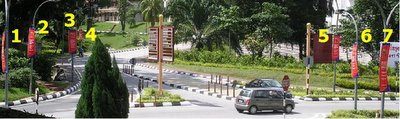 BEFORE: Pictures taken on November 13th
 AFTER: Pictures taken on November 18th
As you can see from the pictures above, while there continue to be buntings scattered around the campus, the numbers appears to have declined significantly by some 80-90%.
As "hinted" by the Minister of Higher education, and deduced on this blog earlier, word has been sent to the university's vice-chancellor to remove the silliness of the celebratory billboards and buntings. Although the Deputy Minister of Higher Education, officially denied that there was such "instruction" as reported in the New Straits Times, I was certain that the denial was purely to save the vice-chancellor some face.
Let's all see what happens next.
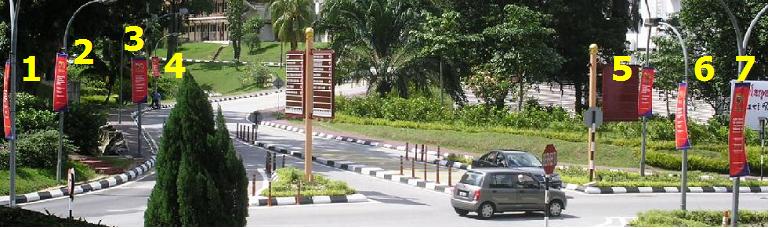 BEFORE: Pictures taken on November 13th
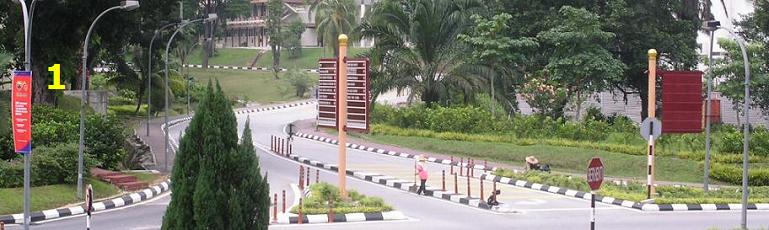 AFTER: Pictures taken on November 18th
As you can see from the pictures above, while there continue to be buntings scattered around the campus, the numbers appears to have declined significantly by some 80-90%.
As "hinted" by the Minister of Higher education, and deduced on this blog earlier, word has been sent to the university's vice-chancellor to remove the silliness of the celebratory billboards and buntings. Although the Deputy Minister of Higher Education, officially denied that there was such "instruction" as reported in the New Straits Times, I was certain that the denial was purely to save the vice-chancellor some face.
Let's all see what happens next.
Friday, November 18, 2005
Universiti Malaya: "The True State of Affairs"
As highlighted in the earlier post, the vice-chancellors of Universiti Malaya (UM) and Universiti Sains Malaysia (USM) will be having a meeting with QS Quacquarelli Symmonds founder, Nunzio Quacquarelli on the November 21st. The event is held just before QS annual World MBA Tour in Kuala Lumpur to be held at the Westin from 5pm to 9pm on Tuesday, 22nd November.
However, thanks to a post and a scanned leaflet by LONE, I understand that there is actually a Forum being held at Balai Ungku Aziz in UM on November 21st @ 2.30pm, conducted by Mr Quacquarelli himself. The main title for the event is "The THES Top 200 World Class Universities", and subtitled "UM in the THES 2005 International Ranking: The True State of Affairs".

Unfortunately attendance is by invitation only, and this blogger has a day job which has booked him for an important presentation on Monday and will be unable to gatecrash the event.
But to anyone out there who has an invitation or is able to gatecrash, do keep me updated as to what was "discussed" during the forum.
However, based on the publicity leaflet alone, I'm prepared to put a little of my hard earned cash on the table to wager that QS, being a profit oriented commercial entity and its founder, will unlikely attempt a "Al Gore", making his host and possibly future periuk nasi lose face. The vice-chancellor of UM will likely have another opportunity to have someone sing "praises" on his new clothes. If only he looks into the mirror to see "The True State of Affairs".
However, thanks to a post and a scanned leaflet by LONE, I understand that there is actually a Forum being held at Balai Ungku Aziz in UM on November 21st @ 2.30pm, conducted by Mr Quacquarelli himself. The main title for the event is "The THES Top 200 World Class Universities", and subtitled "UM in the THES 2005 International Ranking: The True State of Affairs".
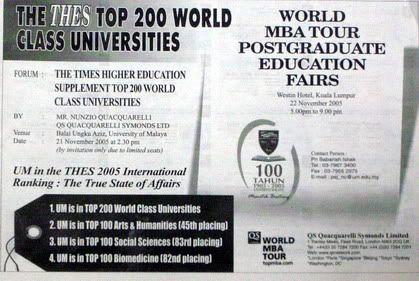
Unfortunately attendance is by invitation only, and this blogger has a day job which has booked him for an important presentation on Monday and will be unable to gatecrash the event.
But to anyone out there who has an invitation or is able to gatecrash, do keep me updated as to what was "discussed" during the forum.
However, based on the publicity leaflet alone, I'm prepared to put a little of my hard earned cash on the table to wager that QS, being a profit oriented commercial entity and its founder, will unlikely attempt a "Al Gore", making his host and possibly future periuk nasi lose face. The vice-chancellor of UM will likely have another opportunity to have someone sing "praises" on his new clothes. If only he looks into the mirror to see "The True State of Affairs".
Yes, It Was A Mistake
Finally, the exact "truth" is out of the bag with regards to the controversy over the "achievement" by Universiti Malaya (UM) and Universiti Sains Malaysia (USM) in the Times Higher Education Supplement (THES) world rankings table. The "truth" has been speculated by the bloggers on this site for a long time now, and it's finally confirmed through a Star newspaper report today.
Nunzio Quacquarelli, managing director of QS Quacquarelli Symonds which compiled the rankings, clarified that the mistake occurred because they were not aware of Malaysia’s racial composition.
So what's next? As highlighted earlier, UM and USM vice-chancellors are planning a meeting with QS Quacquarelli Symonds on the 21st November.
To give a bit of background to QS, their mission is to to connect educational and corporate "recruiters with graduates, young professionals and experienced executives in the most cost-effective manner. [They] combine web, print and event solutions to help companies and candidates make the match."
Hence, QS is essentially a firm selling MBA and other postgrad programmes on behalf of universities (e.g., organising the TopMBA education fair in Kuala Lumpur currently) as well as a headhunting agency for worldwide multinationals specifically targetting "the most talented international candidates". They are NOT academics or experts in higher education systems per se, but a commercial entity with a research arm which compiles data (most large inernational headhunting firms do).
So, what will the UM and USM administrators obtain out of the meeting with them besides additional confirmation that they made a mistake? I seriously hope that USM is not going to pay money for that information, having reported earlier that they have "engaged" a "London-based consultant".
Putting on a (very) cynical hat, the UM vice-chancellor could possibly do the following:
1. Take legal action against THES and QS for causing UM untold embarrassment and unnecessary expenses incurred for putting up large billboards, banners and print advertisements, on the false pretext of being 89th in the world.
2. Make suggestions to QS to incorporate other criterias which will allow Malaysian universities to perform better. For example, the level of government interference, the level of multi-cultural interaction and exposure and the number of "awards" won at trade fairs (instead of just mere academic citations).
3. Seek and identify potential "loopholes" in the existing methodology which may be "exploited" to achieve better ranking scores. For example, allocating 20% of the undergraduate enrolments to students some country in god-knows where.
4. Engage QS to be an offical consultant to the universities in whatever capacity, in the hope that the Malaysian universities will be shown in a better (and possibly more sympathetic) light.
After all, the "spin" from QS (understandable, as it's a commercial entity seeking new or more business) have begun with the press statement in the Star, trying to "cushion" the impact of the poor overall rankings achieved by the Malaysian universities. The Star article actually started with:
Nunzio Quacquarelli, managing director of QS Quacquarelli Symonds which compiled the rankings, clarified that the mistake occurred because they were not aware of Malaysia’s racial composition.
"Last year, the Chinese and Indian students were classified as foreign nationals; this resulted in Malaysia getting very high marks under the international students category. However, once the marks were adjusted this year, there was a big change of position for both universities."So that's that. The entire expensive celebrations exercises conducted by UM for the great "achievement" of 89th position, were based based on poor data (which should have been recognised in the first place by any half-decent university academic) is a celebration over a refereeing blunder. A major brouhaha over a non-achievement.
So what's next? As highlighted earlier, UM and USM vice-chancellors are planning a meeting with QS Quacquarelli Symonds on the 21st November.
To give a bit of background to QS, their mission is to to connect educational and corporate "recruiters with graduates, young professionals and experienced executives in the most cost-effective manner. [They] combine web, print and event solutions to help companies and candidates make the match."
Hence, QS is essentially a firm selling MBA and other postgrad programmes on behalf of universities (e.g., organising the TopMBA education fair in Kuala Lumpur currently) as well as a headhunting agency for worldwide multinationals specifically targetting "the most talented international candidates". They are NOT academics or experts in higher education systems per se, but a commercial entity with a research arm which compiles data (most large inernational headhunting firms do).
So, what will the UM and USM administrators obtain out of the meeting with them besides additional confirmation that they made a mistake? I seriously hope that USM is not going to pay money for that information, having reported earlier that they have "engaged" a "London-based consultant".
Putting on a (very) cynical hat, the UM vice-chancellor could possibly do the following:
1. Take legal action against THES and QS for causing UM untold embarrassment and unnecessary expenses incurred for putting up large billboards, banners and print advertisements, on the false pretext of being 89th in the world.
2. Make suggestions to QS to incorporate other criterias which will allow Malaysian universities to perform better. For example, the level of government interference, the level of multi-cultural interaction and exposure and the number of "awards" won at trade fairs (instead of just mere academic citations).
3. Seek and identify potential "loopholes" in the existing methodology which may be "exploited" to achieve better ranking scores. For example, allocating 20% of the undergraduate enrolments to students some country in god-knows where.
4. Engage QS to be an offical consultant to the universities in whatever capacity, in the hope that the Malaysian universities will be shown in a better (and possibly more sympathetic) light.
After all, the "spin" from QS (understandable, as it's a commercial entity seeking new or more business) have begun with the press statement in the Star, trying to "cushion" the impact of the poor overall rankings achieved by the Malaysian universities. The Star article actually started with:
The good news is that two Malaysian universities did not really drop significantly in the world university rankings.Is that "good news"? Quacquarelli also added that
...despite the sharp fall in its overall position, UM had improved tremendously. If you look at peer review, which accounts for 40% of the marks, UM rose 41 places to 80.If we are going to hire consultants to improve our universities (not the rankings) and the overall higher education system, then the Ministry of Higher Education should engage genuine and reputable education consultants from any of the top 10 universities of world, and not a headhunting and statistics compilation firm.
Thursday, November 17, 2005
The English Language Debate Continues… (Part II)
I’ve written on the Part I of this post with regards to the arguments most often presented by the Chinese educationists in support of reverting back to teaching Science and Mathematics in the students’ mother tongue, particularly for Chinese vernacular schools. I’ve also presented my views with regards to why the arguments are not completely sound.
I’ve also been criticised by several readers (who, I must say, write really well) in some of my earlier post with regards to this topic, with a few who commented that due to the fact that I lack a background in Chinese education, I’m unable to understand the issues concerning Chinese vernacular education and that I’m biased against vernacular education. One of the readers have argued that:
Firstly, my supporting the teaching of Mathematics and Science in English is indeed pretty much along the “official lines”. My only qualms with it are its implementation and execution, not its objectives. I don’t think there’s anything wrong with being part of the “official lines”, if the “official lines” are indeed the right thing to do. Irrationality comes in when one thinks that everything “official” is by definition, suspicious and wrong.
Secondly, I'll be the first to admit that my grasp of “Chinese” philosophy and culture is not at the level which I really wish I had. However, to say that I “despise the culture”, ooh… that’s just a little bit too harsh isn’t it? :) If you have read some of my other posts, I should hope that you’d be able to see and know that:
Both the Chinese and the English language (and even Bahasa Melayu) are extremely important, particularly for Malaysians who live in the Malay archipelago in between the modern English and the growing Chinese world. There is hence a need for balance. My arguments to continue the pursuit of the objectives of the policy are fairly straightforward.
“I not so agree(?)”
The standard of English among students originating from Chinese primary schools are extremely weak, often atrocious.
I know this purely from hiring some of the top students from the top local universities. These are students who scored more than 5-6 As for the SPM and achieved a cumulative grade point average (CGPA) of at least 3.3.
The “I not so agree” statement is just a direct transliteration from the Chinese statement “wo bu tai tong yi” (我不太同意). This statement is at least, understandable. There are many many other examples of emails and reports that I can cite, which unfortunately need to be heavily edited and re-written before I am able to submit them to clients. Feel free to study more examples here and here.
If these are the standards of the bulk of the top students from Chinese primary school background, then I cannot imagine the state of English language skills among the typical average (or poor) Chinese school students.
And the practical reasons why the English language is so darn important? Here’s just two for your consideration.
As quoted by many readers, there are always going to be successful exceptions i.e., students who did well in vernacular Chinese schools, who were able to still switch and pick up new language skills successfully later in secondary and university education.
My wife, Ting Fong herself is proof of such exceptions. She did her 6 years of Chinese primary school education, 5 years of Sekolah Menengah Kebangsaan (SMK), 2 years of Junior College (JC) in Singapore, and 3 years of Law at Oxford. She literally 'aced' all her subjects (and puts me to shame). But she'll be the first to admit that she struggled badly during her first 3-6 months in Singapore with the language switch, and once again, the first 3 months at Oxford. In JC, she had her history essays literally thrown back to her unmarked because the tutor said he couldn't understand what she was writing - and she was the top English student (and the President of the English society) for some 10 years before that!
I for one, would never have had the opportunity to study at Oxford if I wasn't fortunate enough to have switch to a completely English medium in Singapore immediately after primary school (giving me, a slightly slower language learner more time to adapt).
But as highlighted, those like Ting Fong are exceptions. They have managed to do well despite the challenges they faced in the language. Many others who did well were fortunate enough to be based in large urban centres whereby the parents were already competent in English to aid their children. However, there are probably more than 80% (guesstimate) of Chinese school students who are not part of these exceptions, who should be provided with as much exposure to the English language as possible so that the opportunities for them in the future will be brighter both in terms of obtaining top quality further education as well as career advancement and prospects.
In this English language policy debate, we should appraise the system based not so much on what's good for the "Chinese schools", but what's best for the students and their future. In this respect, I'm happy that the Prime Minister has emphasised that the policy to teach Mathematics and Science in English is here to stay.
I’ve also been criticised by several readers (who, I must say, write really well) in some of my earlier post with regards to this topic, with a few who commented that due to the fact that I lack a background in Chinese education, I’m unable to understand the issues concerning Chinese vernacular education and that I’m biased against vernacular education. One of the readers have argued that:
Your supporting teaching Math/Science in English sounds a bit too much like rationalizing for the official lines. You appear to have stopped thinking rationally out of despise for a culture that you have not learned well.So, I’ll spend the Part II of this post to give a quick reply to the criticisms I received above, as well as to present very simple straightforward arguments why the teaching of Science and Mathematics in English is beneficial to the students.
Firstly, my supporting the teaching of Mathematics and Science in English is indeed pretty much along the “official lines”. My only qualms with it are its implementation and execution, not its objectives. I don’t think there’s anything wrong with being part of the “official lines”, if the “official lines” are indeed the right thing to do. Irrationality comes in when one thinks that everything “official” is by definition, suspicious and wrong.
Secondly, I'll be the first to admit that my grasp of “Chinese” philosophy and culture is not at the level which I really wish I had. However, to say that I “despise the culture”, ooh… that’s just a little bit too harsh isn’t it? :) If you have read some of my other posts, I should hope that you’d be able to see and know that:
- My mother tongue, i.e., the language which I communicate with my parents is Mandarin and nothing else.
- My current lingua franca at home with my wife and daughter is Mandarin
- I’ve written on the importance of the Chinese language
- I wrote to my parents in Chinese while I was at university
- I wrote to my wife-to-be in Chinese too regularly for 3 years while she was at university, after I have graduated :-)
- As recent as last year, I took Chinese tuitioin classes to strengthen my Chinese technical and business skills to communicate with Chinese businessmen in China.
- I took Confucian Studies (and aced it) for my ‘O’ Levels in Singapore.
Both the Chinese and the English language (and even Bahasa Melayu) are extremely important, particularly for Malaysians who live in the Malay archipelago in between the modern English and the growing Chinese world. There is hence a need for balance. My arguments to continue the pursuit of the objectives of the policy are fairly straightforward.
“I not so agree(?)”
The standard of English among students originating from Chinese primary schools are extremely weak, often atrocious.
I know this purely from hiring some of the top students from the top local universities. These are students who scored more than 5-6 As for the SPM and achieved a cumulative grade point average (CGPA) of at least 3.3.
The “I not so agree” statement is just a direct transliteration from the Chinese statement “wo bu tai tong yi” (我不太同意). This statement is at least, understandable. There are many many other examples of emails and reports that I can cite, which unfortunately need to be heavily edited and re-written before I am able to submit them to clients. Feel free to study more examples here and here.
If these are the standards of the bulk of the top students from Chinese primary school background, then I cannot imagine the state of English language skills among the typical average (or poor) Chinese school students.
And the practical reasons why the English language is so darn important? Here’s just two for your consideration.
- The bulk of communication, written and verbal, done in large local and multinational companies in Malaysia, particularly in the higher management levels is undeniably, English.
- Barring a few exceptions, the top 50 universities in the world (using whichever rankings table), uses English as the language medium.
As quoted by many readers, there are always going to be successful exceptions i.e., students who did well in vernacular Chinese schools, who were able to still switch and pick up new language skills successfully later in secondary and university education.
My wife, Ting Fong herself is proof of such exceptions. She did her 6 years of Chinese primary school education, 5 years of Sekolah Menengah Kebangsaan (SMK), 2 years of Junior College (JC) in Singapore, and 3 years of Law at Oxford. She literally 'aced' all her subjects (and puts me to shame). But she'll be the first to admit that she struggled badly during her first 3-6 months in Singapore with the language switch, and once again, the first 3 months at Oxford. In JC, she had her history essays literally thrown back to her unmarked because the tutor said he couldn't understand what she was writing - and she was the top English student (and the President of the English society) for some 10 years before that!
I for one, would never have had the opportunity to study at Oxford if I wasn't fortunate enough to have switch to a completely English medium in Singapore immediately after primary school (giving me, a slightly slower language learner more time to adapt).
But as highlighted, those like Ting Fong are exceptions. They have managed to do well despite the challenges they faced in the language. Many others who did well were fortunate enough to be based in large urban centres whereby the parents were already competent in English to aid their children. However, there are probably more than 80% (guesstimate) of Chinese school students who are not part of these exceptions, who should be provided with as much exposure to the English language as possible so that the opportunities for them in the future will be brighter both in terms of obtaining top quality further education as well as career advancement and prospects.
In this English language policy debate, we should appraise the system based not so much on what's good for the "Chinese schools", but what's best for the students and their future. In this respect, I'm happy that the Prime Minister has emphasised that the policy to teach Mathematics and Science in English is here to stay.
More Brickbats for Universiti Malaya
Yesterday, the Sun, who has been exemplary in the past week in highlighting the issues pertaining to the crisis faced by Universiti Malaya (UM), used for the first time in the print media, the word “idiotic” to describe the actions of UM administrators to date. Nik Nazmi Nik Ahmad wrote that
And in a most tactful and diplomatically damning comment on Universiti Malaya to date, Azmi Shahrom wrote on “How To Judge a Good University” in today’s copy of the Sun. What makes his assessment particularly meaningful, is that he is actually an Associate Professor and the Deputy Dean of the Law Faculty in Universiti Malaya.
Read the complete article in the Sun, for you won’t find another well-written commentary on university education which is able to make analogous comparisons to “sex” and “powerful kissing lips”! More seriously, he argued that:
However, the reason why the rankings table is so “important” in the discussions at this stage is that it provides a focus for the academics and education authorities to focus their attention on the state of higher education in Malaysia. The effect of the severe drop in rankings of UM have galvanised the public, the media and hopefully at the end of the day, the education and university authorities to take the necessary steps (even if they are baby steps for a start) towards reversing the decline in our university quality and reputation.
Without the initial debate on the rankings table, and the position of Malaysian universities in them, there would never have seen some of the discussions with regards to the setting up of “search committees” for university vice-chancellors, the public calls to improve the state of our universities, the set up of a parliamentary committee on education etc., as highlighted in my earlier post here. At some point down the road, the debate on the actual rankings table should cease to take prominence while the actual steps needed to transform our higher education system takes precedence.
The shift in debate is already taking place. Nik Nazmi commented on his Sun piece that:
1. Transparency in Promotion
[t]he handling of the universities in dealing with this drop in rankings especially UM's administration can at best be described as confused, if not downright idiotic.The Star also headlined an article “It’s no cause for jubilation”, quoting Deputy Minister of Higher Education, Fu Ah Kiow.
And in a most tactful and diplomatically damning comment on Universiti Malaya to date, Azmi Shahrom wrote on “How To Judge a Good University” in today’s copy of the Sun. What makes his assessment particularly meaningful, is that he is actually an Associate Professor and the Deputy Dean of the Law Faculty in Universiti Malaya.
Read the complete article in the Sun, for you won’t find another well-written commentary on university education which is able to make analogous comparisons to “sex” and “powerful kissing lips”! More seriously, he argued that:
Instead of strutting around like a bunch of peacocks, a sober examination of the ranking system and how it can help us improve should have been done. Now that UM is at 169, the same thing should be done instead of hthe hopelessly silly PR exercises of spin doctoring which has the appearance of the self same peacock waving its moulted feathers in desperation.There has also been a few but noticeable criticisms with regards to this entire Universiti Malaya rankings crisis debate. They have argued that by focusing on the “rankings table”, we are missing the woods for the trees as if we were to take care of providing quality education, the rankings table will sort itself out. I agree.
However, the reason why the rankings table is so “important” in the discussions at this stage is that it provides a focus for the academics and education authorities to focus their attention on the state of higher education in Malaysia. The effect of the severe drop in rankings of UM have galvanised the public, the media and hopefully at the end of the day, the education and university authorities to take the necessary steps (even if they are baby steps for a start) towards reversing the decline in our university quality and reputation.
Without the initial debate on the rankings table, and the position of Malaysian universities in them, there would never have seen some of the discussions with regards to the setting up of “search committees” for university vice-chancellors, the public calls to improve the state of our universities, the set up of a parliamentary committee on education etc., as highlighted in my earlier post here. At some point down the road, the debate on the actual rankings table should cease to take prominence while the actual steps needed to transform our higher education system takes precedence.
The shift in debate is already taking place. Nik Nazmi commented on his Sun piece that:
But it is futile to dwell too much on the ranking issue, without seeing it in perspective: it's a symptom of deeper problems plaguing Malaysian higher education.And today, Azmi Shahrom followed up with the extremely constructive piece of some of the critical actions that need to be taken to ensure the quality of our universities and their graduates are raised. Some of his criticisms, comments and suggestions include:
The major problems that we can see include the absence of genuine meritocracy; the lack of academic and political freedom in campuses; the prevalence of unemployment for many graduates; the poor command of English and a lack of focus in the direction of our education policy.
1. Transparency in Promotion
... make sure that good academics join and stay... make sure the working environment is conducive to research and those who are able to do good work are promoted. Good work here meaning publishable research by respected publishers and journals (not lifestyle magazines) and sound teaching; not administrative duties and brown nosing. This can be done quite simply by ensuring that the promotion process is open and transparent, for example by publishing the CVs of all successful candidates.2. Foreign Faculty and Student Intake
Artificially enticing foreign students and lecturers will simply not work and in the long run will be disastrous for the institution. Artificial means would include lowering the standards so as to take in any Tom, Dick and Harry to study or work here; begging foreign universities to have student exchange programmes with us; or by paying huge amounts of money just to have foreign professors lend their name to our staff lists with little or no actual responsibility.3. Quality of Graduates
The hard fact of the matter is that, by and large, our graduates do not have the sort of qualities that would make overseas employers want them, or do our graduates have the qualitites to go out beyond the coconut shell to offer their services to the world.Coming from the Deputy Dean of the Law Faculty of University Malaya - who's clearly no buddy of the vice-chancellor, there's really nothing more I need to add. Go read his piece. And I hope those at the Ministry of Higher Education read it too.
This is because Malaysian public universities treat students like children. Their freedom of speech is curtailed. Their freedom of assembly is controlled. Their freedom to vote is interfered with. Without such freedoms, students can't grow. ... they won't have the confidence, the chutzpah to grab the world by the throat and scream their arrival.
Wednesday, November 16, 2005
The English Language Debate Continues… (Part I)
Two years after the policy to teach Science and Mathematics in English has been implemented, the great debate on the use of English language, particularly in the Chinese vernacular schools continue. Regular readers of this blog will know that I’ve commented at frequently on the issue, and I’ve attracted plenty of responses on my posts. The readers will also know that I’m pretty much in favour of the policy to continue the teaching of the two subjects in English.
Recently, the debate has heated up again with Dong JiaoZong (DJZ), the leading Chinese educationist organisation making frequent press statements, and the new Gerakan vice-president and Penang Chief Minister, Tan Sri Dr Koh Tsu Koon joining the fray of those seeking to abolish the English language policy. I’d assume that the debate typically heats up towards the end of every year due to the fact that it would be the opportune time for the policy to be revised to meet the new schooling year.
The arguments for the teaching of Science and Mathematics using the children’s mother tongue has not changed over the last few years. I’ve also received some fairly well written brickbats (which can occasionally be pretty harsh - more on this later) from readers with regards to my stand on the issue. These arguments include:
1. Better ability to grasp mathematical and science concepts in mother tongue
To me, if the objectives are noble and right, but the implementation was weak, we should work to improve delivery and not instead, throw out the objectives.
As for the brickbats I mentioned earlier, quite a few readers have commented that due to the fact that I lack a background in Chinese education, I’m unable to understand the issues concerning Chinese vernacular education and that I’m biased against vernacular education.
One posted that:
The Part II of this blog post will cover my (hopefully even-headed) response to such criticisms, as well as my personal simple argument why the teaching of Mathematics and Science in English is the right move for Malaysian children. And in case you think that I'm anti-whatsoever-Chinese, have a read at this earlier post first.
Recently, the debate has heated up again with Dong JiaoZong (DJZ), the leading Chinese educationist organisation making frequent press statements, and the new Gerakan vice-president and Penang Chief Minister, Tan Sri Dr Koh Tsu Koon joining the fray of those seeking to abolish the English language policy. I’d assume that the debate typically heats up towards the end of every year due to the fact that it would be the opportune time for the policy to be revised to meet the new schooling year.
The arguments for the teaching of Science and Mathematics using the children’s mother tongue has not changed over the last few years. I’ve also received some fairly well written brickbats (which can occasionally be pretty harsh - more on this later) from readers with regards to my stand on the issue. These arguments include:
1. Better ability to grasp mathematical and science concepts in mother tongue
In a Star report, Tan Sri Dr Koh Tsu Koon was quoted arguing that2. That the policy does not at all help improve the competency in English[i]t will be more effective if Science and Mathematics are taught in the mother tongue in primary schools… this allowed the pupils of different communities to understand the two subjects better if they were taught in a language they were accustomed to.I actually do not disagree with the above argument at all. In the short term, students will definitely learn Science and Mathematics in their mother tongue. However, if we are always looking at things purely from the perspective of what’s “easier” and more convenient in the short term, then we’ll never be able to see the woods for the trees.
To quote Zainal Arifin in his Intermission commentary in the New Straits Times on the 9th November:My answer to that is never underestimate the sponge-like ability of children to absorb new information, whatever language they come in. It is often adults, driven by adult agendas, who have trouble sleeping on it.What I strongly believe is that once the initial teething issues have been ironed out, students will not have major issues coping with learning the two subjects in English. They are after all, still assisted with “translations” in their mother tongue. Take a very simple example across the border, the Chinese students in Singapore from the “heartlands” whose mother tongue remains Chinese, do not have any major issues or problems with learning Science and Mathematics in English at all!
The other argument against the policy commonly used is that teaching the subjects in English does not assist the learning of the language. The authorities should instead increase the number of class periods allocated for the teaching of English language.3. Preserving the character of vernacular schools
The argument that the number of periods to be allocated to teach English should be increased has merit. However, to claim that teaching the subjects in English do not help improve the competency of the language is totally out of place.
Once again, to quote Zainal:The idea of teaching Science and Mathematics in English is rooted in the belief that, as for most things in life, we get better at something if we do it often enough. A prolonged exposure to English beyond the language class will make our children more comfortable with it, and help them develop an affinity for it.There is only so much “Bahasa Inggeris” classes can help with one’s competency of the language. If the children are not exposed to the language regularly beyond the 2 (or 3 or 4) periods of English classes a week, they are never going to be fluent in the language. Exposure to other subjects such as Science and Mathematics in English will help the students gain additional familiarity with the language.
There are those who argue that the best way to pick up the language is really to “read and read some more”. And there have been plenty of instances cited on this blog by readers (e.g., here and here) who were able to ensure that their children are effectively bilingual (or even trilingual) through proper guidance and encouragement at home. I cannot agree more that these are probably the most effective ways to pick up the language.
However, we cannot forget that the likely majority of Chinese school students are not borne of English conversant families. My parents for example, barely knew twenty words of English combined. Without the additional exposure, the 2 periods of English classes a week are likely to be the only ever “sustained” exposure to the language for six years of their primary school life.
The third argument often cited is the fear that the English policy is an attempt by the Government to destroy the character of vernacular schools. I find such apprehension far fetched, as the policy is uniformly applied across national schools as well, much to the chagrin of Malay language nationalists.My personal issues with the teaching of Mathematics and Science in English have always been with its poor implementation and administration, not with its objectives. The “roll-out” of the system was too rushed and haphazard under the previous Education Minister, particularly with regards to the training received by the teachers, who had to conduct lessons in a language they themselves were not fully competent in. Some have also complained on the thickness and weight of the new biligual textbooks!
The Chinese vernacular schools have not lost any of its character in the past 2 years of implementation, and I don’t see them as being any less “Chinese” than it was before. All the other subjects continue to be taught in Chinese language and the medium of communication in the schools are almost certainly Mandarin or other Chinese dialects.
Now, lets say, for the sake of argument, that the “character” of vernacular schools is indeed “altered” a little bit with the introduction of the English teaching policy. The question is, if it does works out to the benefit of the children and their future – why should we be so blinded by the absolute “preservation” of "character" to deny improved opportunities for the children?
To me, this third argument is the weakest of all the arguments put forth to review the language policy in Malaysian vernacular (and national) schools.
To me, if the objectives are noble and right, but the implementation was weak, we should work to improve delivery and not instead, throw out the objectives.
As for the brickbats I mentioned earlier, quite a few readers have commented that due to the fact that I lack a background in Chinese education, I’m unable to understand the issues concerning Chinese vernacular education and that I’m biased against vernacular education.
One posted that:
You don't understand what DongZong is doing because you don't read Chinese newspaper, I doubt you read any of the paper released by the organisation. Your source of information on this issue probably comes from English or Malay medium papers, which only tell you what they want you to know and think.And another even argued that:
Your supporting teaching Math/Science in English sounds a bit too much like rationalizing for the official lines. You appear to have stopped thinking rationally out of despise for a culture that you have not learned well.Ouch! Ouch! Ouch!
The Part II of this blog post will cover my (hopefully even-headed) response to such criticisms, as well as my personal simple argument why the teaching of Mathematics and Science in English is the right move for Malaysian children. And in case you think that I'm anti-whatsoever-Chinese, have a read at this earlier post first.
Tuesday, November 15, 2005
Universiti Malaya VC: Under Pressure, Unrepentent
Hey, I'm back after the brief internet-not-very-accessible break, and wow, plenty of things to blog about! :) My wife will be upset to hear this, but I "almost" wish I wasn't away, in a "happening" period like this. This is with reference to the state of our higher education system, epitomised by Universiti Malaya's love affair with the Times Higher Education Supplement (THES) world university rankings.
So what have I missed? I'll summarise them into the Good, the Bad and the Ugly, as well as give you a Low Down on what I personally think!
The Good
1. Deputy Higher Education Minister makes sensible statement
After making a silly and ill-informed statement immediately after the release of the THES world rankings table, our Deputy Minister of Higher Education has, probably after the increased media comment on the issue, released a statement which had the right messages. Sdr Fu Ah Kiow, as been quoted by Malaysiakini to say that
2. Higher Education Minister gave 'positive' feedback
Our Parliamentary Opposition leader, Sdr Lim Kit Siang who has been at the forefront of pressing the need for a review of our higher education minister, has finally been granted an audience with our Minister of Higher Education, Datuk Shafie Salleh. The outcome of the meeting appears positive, with several developments expected over the coming weeks (months?). Most importantly, Datuk Shafie Salleh appears to have agreed to support the set up of a Parliamentary Select Committee on Higher Education.
3. The VC search committee
The Minister of Higher Education has also announced the likely set up of a "search committee" to select future vice-chancellors of Malaysian universities.
Interestingly enough, the Universiti Kebangsaan Malaysia (UKM) Vice Chancellor Prof Datuk Dr. Mohd Salleh Mohd Yasin’s response was most noteworthy when he commented:
4. The is significantly increased awareness
I would like to think that the effort of the blogging community has not been in vain with regards to this issue, and I strongly believe that the mainstream press has caught up with the truth and details of the issue, thanks to readers and bloggers out there. In the past 4-5 days, there has been many articles (some of which I'm certain to have missed) appearing in both the English and Chinese press.
The Sun started on Wednesday last week with Citizen Nades asking if it's appropriate for UM to abuse the images of the nation's leaders. Oon Yeoh has put up his comment piece appearing in the Sun on Saturday, drawing from the findings arrived at this very blog. They've today, followed up with an editorial calling to "stop the rot... from the top".
There are of course many more blogs and letters published in the newspapers which have brought this issue to the forefront, making it unlikely to be easily brushed aside by those seeking to have the controversy brushed under the carpet.
The Bad
1. Parliament Rejects Debate on UM
The Sun highlighted that the Dewan Rakyat rejected an emergency motion tabled by Opposition Leader Lim Kit Siang to debate UM's fall in the worldwide rankings.
Unsurprisingly, there was another letter appearing the Star, heaping more praise and accolades on University Malaya and its Vice-Chancellor. What I'm actually surprised is that there weren't more such letters! Interestingly enough, while the earlier letter of support was from UM's Dean of Engineering Faculty, this time round, it was just from a nameless "Concerned Academic Staff" of UM.
The "concerned academic" argued that the "drop in ranking was due to factors beyond UM's control".
One such factor was the fact that there was no foreign undergraduates in UM leading obviously to a poor "international student" score. This is true, but the "academic" forgets that this score only constitutes 5% of the overall score, and most universities which performed better than UM, had poor scores for this criteria anyway.
Another factor cited was the "employability of our graduates".
The following paragraphs from the letter is the most sadly laughable parts, only serving as new anecdotes to be added to my earlier post entitled "The Art of Flattery @ UM".
The Ugly
The ugliest of what has happened over the last few days is strictly reserved for the UM Vice Chancellor, who remains absolutely unrepentent and recalcitrant.
As highlight in plenty of blogs, as well as here, the VC has obviously found the funds and time to order a new set of some 150 buntings and banners to be hung all around the campus. He has obviously not learnt his lessons.
What's worse, the vice-chancellor has decided to print his own propaganda materials and flood the campus students and academics with them, in an apparent act to "justify" his position. Read all about it here @ Sdr Lim Kit Siang's blog.
The Low Down
So what's the gut feel over the events of the past week? I'm actually feeling a tad optimistic, more optimistic than I was before my little break anyway.
Both the Minister of Higher Education and his deputy are now singing the same tune, and the right one too - that the crisis facing our higher education is not something to be swept under the carpet. Enough information has been provided and pressure has been applied to ensure that they are made aware of the truth of the circumstance, and not be easily satisfied or hoodwinked with explanations from the university administrators who have been too wily and economical with the truth.
Parliamentary Select Committees, for those familiar with political institutions and processes, are extremely important parts of the function of a assertive Parliament. One of the reasons for weaknesses in our local parliament, and hence its "rubber stamp" reputation, is not just in the overwhelming majority secured by Barisan National, but also in the (non)existence of secondary institutions within the Parliament. These secondary institutions will ensure greater contribution from Members of Parliament in the decision making process. It is not a step which will have dramatic effects overnight, but it's nevertheless an important step towards better governance, in this case, of our education system.
The response from the media, bloggers and public has been fantastic, quite beyond my own, and if I may speculate on his behalf, Kian Ming's expectations. The outright truth is being told, and I must say, some in the mainstream media are worded harsher than we have been. Needless to say, I believe that the spotlight we have all placed on Universiti Malaya and its vice-chancellor has resulted in plenty of pressure for the vice-chancellor, and for the education authorities to take the necessary actions. We definitely expect and hope that the furore to continue a little while more.
The actions of the vice-chancellor - new buntings, distribution of self written articles - are clearly that of a man forced into a corner, defending for his life in the academia. The fact that he has to focus on distributing propaganda within the university campus may just mean that he is perceiving or expecting a weakening of his authority and reputation even within the campus, and hence the need to "shore" it up. What else will he do?
I personally think that the VC has underestimated the backlash resulting from his actions and he is now in a position of no return for he has burnt his bridges. Had he been more intellectually honest with the entire exercise over the fall in world rankings as late as a week ago, he might have just about saved his seat. Unfortunately, I do think that his seat might just be too hot to handle today. We will see.
So what have I missed? I'll summarise them into the Good, the Bad and the Ugly, as well as give you a Low Down on what I personally think!
The Good
1. Deputy Higher Education Minister makes sensible statement
After making a silly and ill-informed statement immediately after the release of the THES world rankings table, our Deputy Minister of Higher Education has, probably after the increased media comment on the issue, released a statement which had the right messages. Sdr Fu Ah Kiow, as been quoted by Malaysiakini to say that
Universiti Malaya (UM) has no reason to 'celebrate' its ranking... since there is a drop from last year... The lower ranking of UM now is not something that we should be glad of... We will discuss the problem. We should take the ranking seriously. We should not be celebrating.Yes, we should not be in a "state of denial" indeed!
We should not be in a state of denial.
2. Higher Education Minister gave 'positive' feedback
Our Parliamentary Opposition leader, Sdr Lim Kit Siang who has been at the forefront of pressing the need for a review of our higher education minister, has finally been granted an audience with our Minister of Higher Education, Datuk Shafie Salleh. The outcome of the meeting appears positive, with several developments expected over the coming weeks (months?). Most importantly, Datuk Shafie Salleh appears to have agreed to support the set up of a Parliamentary Select Committee on Higher Education.
Shafie agreed with the proposal for the establishment of a Parliamentary Select Committee on Higher Education to involve MPs to be active stakeholders in this critical area with far-reaching implications on the country’s international competitiveness, economic development and prosperity. He said he would raise the proposal in Cabinet.In addition, it appears that the Minister have given word to the university authorities to remove the embarrassing billboards which juxtaposed pictures of the nation's leaders against the unabashed self-praise pronouncements. Datuk Shafie Salleh gave the cryptic reply of "Are the billboards still there?" when question by Sdr Lim. :) I can't wait.
3. The VC search committee
The Minister of Higher Education has also announced the likely set up of a "search committee" to select future vice-chancellors of Malaysian universities.
Interestingly enough, the Universiti Kebangsaan Malaysia (UKM) Vice Chancellor Prof Datuk Dr. Mohd Salleh Mohd Yasin’s response was most noteworthy when he commented:
Overseas, the appointment of vice chancellors are largely based on their leadership qualities as well as academic prowess. Now that we are practicing meritocracy, we should select the best candidate for the job.There are probably still many practical issues to be resolved in the set up of such a selection committee, some of which were highlighted by Kian Ming here, but it's definitely an important baby step forward.
4. The is significantly increased awareness
I would like to think that the effort of the blogging community has not been in vain with regards to this issue, and I strongly believe that the mainstream press has caught up with the truth and details of the issue, thanks to readers and bloggers out there. In the past 4-5 days, there has been many articles (some of which I'm certain to have missed) appearing in both the English and Chinese press.
The Sun started on Wednesday last week with Citizen Nades asking if it's appropriate for UM to abuse the images of the nation's leaders. Oon Yeoh has put up his comment piece appearing in the Sun on Saturday, drawing from the findings arrived at this very blog. They've today, followed up with an editorial calling to "stop the rot... from the top".
If vice-chancellors are not good enough, if they serve political interests rather than academic ones, the battle is already lost. We need vice-chancellors who care, who are independent and are genuinely interested in improving academic standards.In another opinion piece published in the Malay Mail on Sunday, Vasanthi Ramachandran asked "how is UM going to pull itself out of its continual decline, when it refuses to accept or address the real issues and problems within the university?"
If the VCs are not up to mark and are more interested in shamelessly promoting themselves and playing to the political gallery and political parties, then they should be replaced by those who can make a real contribution to the university. Here's where the first change should take place.
It is really scary when UM searches for irrelevant excuses to discredit the rankings table when it is not in their favour, and celebrate when it is.And according to Jeff Ooi, who highlighted the issue twice over Saturday and Sunday, this blog was quoted in an article by Liu Jingwen of Oriental Times as well. (If someone could get me a copy of the article, whether hard or soft copy, that'll be great!)
There are of course many more blogs and letters published in the newspapers which have brought this issue to the forefront, making it unlikely to be easily brushed aside by those seeking to have the controversy brushed under the carpet.
The Bad
1. Parliament Rejects Debate on UM
The Sun highlighted that the Dewan Rakyat rejected an emergency motion tabled by Opposition Leader Lim Kit Siang to debate UM's fall in the worldwide rankings.
Speaker Tan Sri Ramli Ngah Talib said although the motion by virtue of2. More "Praise" for the Vice Chancellor
Standing Order 18(1) was specific in nature and of public importance, it was
not urgent.
Ramli said the steps to be taken include instituting peer review of UM, as
well as citation from other peer educational institutions. He also said the ministry had given an assurance that UM' teaching ratio would be improved, including the international perception towards the university.
Unsurprisingly, there was another letter appearing the Star, heaping more praise and accolades on University Malaya and its Vice-Chancellor. What I'm actually surprised is that there weren't more such letters! Interestingly enough, while the earlier letter of support was from UM's Dean of Engineering Faculty, this time round, it was just from a nameless "Concerned Academic Staff" of UM.
The "concerned academic" argued that the "drop in ranking was due to factors beyond UM's control".
One such factor was the fact that there was no foreign undergraduates in UM leading obviously to a poor "international student" score. This is true, but the "academic" forgets that this score only constitutes 5% of the overall score, and most universities which performed better than UM, had poor scores for this criteria anyway.
Another factor cited was the "employability of our graduates".
It is apparent that the employers interviewed for the survey are multinational companies. These companies select graduates from the western countries where they are headquartered. Such preferential treatment is beyond the control of the universities.While I have my personal (serious) doubts on the methodology employed by THES in incorporating this new criteria, the argument put forth by "academic" is flawed. These multinational companies do not operate on the basis of "preferential treatment". They operate by hiring talents globally to ensure sustained growth and profitability of their organisations. The "academic" should take note that despite this apparent "bias", there are still 44 universities in Asia Pacific ranked above Universiti Malaya.
The following paragraphs from the letter is the most sadly laughable parts, only serving as new anecdotes to be added to my earlier post entitled "The Art of Flattery @ UM".
...the overall score in terms of total marks have improved by leaps and bounds if statistical interpretation is anything to go by.
The university's vice-chancellor and administrators have a gigantic task complying with government policies in the best interests of the nation as well as maintaining high academic standards for the campus. Walking this tightrope is a challenge and the vice-chancellor and administrators must be given due credit for their hard work in achieving these objectives simultaneously.
The vice-chancellor has done his best to create a conducive academic and research environment.
We like our vice-chancellor, especially for his academic competence, administrative leadership and, above all, his impartiality and rationality in performing his role. Due credit must be given to him for fostering a great team spirit among the different races and religions during his tenure.
The Ugly
The ugliest of what has happened over the last few days is strictly reserved for the UM Vice Chancellor, who remains absolutely unrepentent and recalcitrant.
As highlight in plenty of blogs, as well as here, the VC has obviously found the funds and time to order a new set of some 150 buntings and banners to be hung all around the campus. He has obviously not learnt his lessons.
What's worse, the vice-chancellor has decided to print his own propaganda materials and flood the campus students and academics with them, in an apparent act to "justify" his position. Read all about it here @ Sdr Lim Kit Siang's blog.
...thousands or even tens of thousands of leaflets, 37 cm by 37 cm, flooded the campus, whether residential colleges or faculties, reproducing an article by Hashim in the local media extolling UM’s “achievements” in the THES World University Ranking 2005.
The Low Down
So what's the gut feel over the events of the past week? I'm actually feeling a tad optimistic, more optimistic than I was before my little break anyway.
Both the Minister of Higher Education and his deputy are now singing the same tune, and the right one too - that the crisis facing our higher education is not something to be swept under the carpet. Enough information has been provided and pressure has been applied to ensure that they are made aware of the truth of the circumstance, and not be easily satisfied or hoodwinked with explanations from the university administrators who have been too wily and economical with the truth.
Parliamentary Select Committees, for those familiar with political institutions and processes, are extremely important parts of the function of a assertive Parliament. One of the reasons for weaknesses in our local parliament, and hence its "rubber stamp" reputation, is not just in the overwhelming majority secured by Barisan National, but also in the (non)existence of secondary institutions within the Parliament. These secondary institutions will ensure greater contribution from Members of Parliament in the decision making process. It is not a step which will have dramatic effects overnight, but it's nevertheless an important step towards better governance, in this case, of our education system.
The response from the media, bloggers and public has been fantastic, quite beyond my own, and if I may speculate on his behalf, Kian Ming's expectations. The outright truth is being told, and I must say, some in the mainstream media are worded harsher than we have been. Needless to say, I believe that the spotlight we have all placed on Universiti Malaya and its vice-chancellor has resulted in plenty of pressure for the vice-chancellor, and for the education authorities to take the necessary actions. We definitely expect and hope that the furore to continue a little while more.
The actions of the vice-chancellor - new buntings, distribution of self written articles - are clearly that of a man forced into a corner, defending for his life in the academia. The fact that he has to focus on distributing propaganda within the university campus may just mean that he is perceiving or expecting a weakening of his authority and reputation even within the campus, and hence the need to "shore" it up. What else will he do?
I personally think that the VC has underestimated the backlash resulting from his actions and he is now in a position of no return for he has burnt his bridges. Had he been more intellectually honest with the entire exercise over the fall in world rankings as late as a week ago, he might have just about saved his seat. Unfortunately, I do think that his seat might just be too hot to handle today. We will see.
Monday, November 14, 2005
Attack of the Banners, Episode III
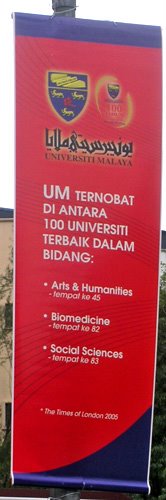
Again, I couldn't believe my eyes when I saw the pictures in Jeff Ooi's and Kit Siang's blogs. I thought that 'pasting' over last year's results were bad enough. This is going overboard. The UM VC must have worked his printers overtime to create these posters in a relatively short time. Maybe he should take out a few full page advertisements in the Star, the NST, Utusan and Berita Harian, publicizing the latest UM 'achievements'. How about using these posters as adverts on the KL buses as well as on the LRTs? Maybe even create an air ballon with these posters?
This only gives us more impetus to keep up the pressure on this guy who is obviously fighting for his survival and will resort to any and all short term tactics instead of planning for real reforms and improvement over the medium and long term.
Sunday, November 13, 2005
Vice-Chancellor's position mostly "administrative"? Think again
It saddens me greatly to read that our Minister of Higher Education, Dr. Shafie Salleh, has once again shown his ignorance of what higher education is about when he proclaimed that a VC need not be an academic because it is primarily an "administrative job". Such a remark shows that he's totally clueless about what is wrong with the state of higher education because a VC's job is much more than just an "administrative" job. As a leader of a research university, one of the VC's most important tasks is to promote the growth of academic excellence in his or her university. Only a person who has had extensive experience within the academic setting would know how to effectively accomplish this objective.
Perhaps Dr. Shafie Salleh should have examined the profile of the presidents or vice-chancellors of some of the better known universities in the world to see if they had an academic background or not for this "administrative" position. Let me list a few of them from the US:
Lawrence Summers - President of Harvard, PhD. in Economics, MIT
Richard Brodhead - President of Duke, PhD. in English, Yale
Shirley Tilghman- President of Princeton, PhD. in Molecular Biology, Temple
Robert Dynes -President of the University of California system, PhD. in Physics, McMaster University
All the aforementioned presidents not only have PhDs but are also or have been former (and some current) professors in their respective fields before taking up their current positions. They know the academic practice in terms of teaching and research because they have been through it and excelled in it as well.
No doubt there are some exceptions to the rule, like the recently appointed President of the University of North Carolina system, Erskine Bowles, former White House chief of staff to President Clinton, but these exceptions are exactly that, exceptions rather than the norm.
Let's look to the UK then.
Alison Richards - Vice-Chancellor of Cambridge, PhD. in Primate Biology, University of London
John Hood - Vice-Chancllor of Oxford, PhD. in Engineering, University of Auckland
Richard Sykes - Rector of Imperical College, PhD. in Biochemistry, Bristol University
Again, there are exceptions including Howard Davies, the director of one of my alma maters, LSE, who was the chairman of the Financial Services Authority in the UK before becoming director of the LSE.
But even the exceptions to the rule have been appointed because of their impressive CVs and vast experience in other fields which are definitely not "administrative", as our Minister puts it. They were appointed to lead their respective universities, not just "administer" them.
How about universities in our region?
Gavin Brown - Vice-Chancellor of Sydney University, PhD. in Mathematics, University of Newcastle-upon-Tyne.
Shih Choon Fong - President of National University of Singapore, PhD. in Engineering, Harvard
Mark Wainwright - Vice-Chancellor of the University of New South Wales, PhD. in Chemical Engineering, McMaster University
I didn't have the time to do this but I bet if you compile a database of the the past 10 presidents / vice-chancellors / rectors / directors of the top 100 universities in the world (using either the THES rankings or the Shanghai Jiaotong rankings), you would find that over 95% of them would have PhDs and would have had academic experience of one sort or another. I wonder if this fact has ever crossed the mind of our Minister of Higher Education?
His accusation of academic 'in-breeding' only applies if this person has been stuck in our local varsity system all his or her life. If one examines the profile of the VCs and Presidents of the top notch universities, one can easily find that most of them would have graduated from a good university, taught in another, and then become VCs or Presidents of their current university. Almost all of them would have impressive CVs and experience of an academic as well as non-academic nature. This surely can't be a sign of the 'in-breeding' that Shafie alleges. Or is he only pointing the finger at the current crop of VCs in Malaysia, specifically the VC of UM?
I have a suspicion that Shafie might have taken a look around and concluded that there might be a possibility that no well-qualified candidate can be found within the local university system for the VC job and that he might have to find someone from the private sector or from the government. Who knows, he might even want to appoint a politician to the post!
I sincerely hope that Shafie doesn't think that the VC's job is a purely "administrative" one in the narrowest sense of the word. A VC's job is multifacted and challenging from many aspects. He has got to push for excellence in academic and research standards, he has got to figure out ways to obtain sufficient funding to achieve these objectives, he has to oversee a recruiting process that will bring in the best and brightest brains to teach in his university and so on (I use 'he' in a generic sense lest I be accused of being sexist).But the fact that he thinks the VC position is merely an "administrative" one leaves me to wonder if he really knows what higher education is about. I've been trying to google him to find our where he got his PhD / medical degree from. Surely he must have gained some insight into higher education from where he got his graduate degree? Can someone help me find this out? Or his "Dr." an honorary title?
Perhaps Dr. Shafie Salleh should have examined the profile of the presidents or vice-chancellors of some of the better known universities in the world to see if they had an academic background or not for this "administrative" position. Let me list a few of them from the US:
Lawrence Summers - President of Harvard, PhD. in Economics, MIT
Richard Brodhead - President of Duke, PhD. in English, Yale
Shirley Tilghman- President of Princeton, PhD. in Molecular Biology, Temple
Robert Dynes -President of the University of California system, PhD. in Physics, McMaster University
All the aforementioned presidents not only have PhDs but are also or have been former (and some current) professors in their respective fields before taking up their current positions. They know the academic practice in terms of teaching and research because they have been through it and excelled in it as well.
No doubt there are some exceptions to the rule, like the recently appointed President of the University of North Carolina system, Erskine Bowles, former White House chief of staff to President Clinton, but these exceptions are exactly that, exceptions rather than the norm.
Let's look to the UK then.
Alison Richards - Vice-Chancellor of Cambridge, PhD. in Primate Biology, University of London
John Hood - Vice-Chancllor of Oxford, PhD. in Engineering, University of Auckland
Richard Sykes - Rector of Imperical College, PhD. in Biochemistry, Bristol University
Again, there are exceptions including Howard Davies, the director of one of my alma maters, LSE, who was the chairman of the Financial Services Authority in the UK before becoming director of the LSE.
But even the exceptions to the rule have been appointed because of their impressive CVs and vast experience in other fields which are definitely not "administrative", as our Minister puts it. They were appointed to lead their respective universities, not just "administer" them.
How about universities in our region?
Gavin Brown - Vice-Chancellor of Sydney University, PhD. in Mathematics, University of Newcastle-upon-Tyne.
Shih Choon Fong - President of National University of Singapore, PhD. in Engineering, Harvard
Mark Wainwright - Vice-Chancellor of the University of New South Wales, PhD. in Chemical Engineering, McMaster University
I didn't have the time to do this but I bet if you compile a database of the the past 10 presidents / vice-chancellors / rectors / directors of the top 100 universities in the world (using either the THES rankings or the Shanghai Jiaotong rankings), you would find that over 95% of them would have PhDs and would have had academic experience of one sort or another. I wonder if this fact has ever crossed the mind of our Minister of Higher Education?
His accusation of academic 'in-breeding' only applies if this person has been stuck in our local varsity system all his or her life. If one examines the profile of the VCs and Presidents of the top notch universities, one can easily find that most of them would have graduated from a good university, taught in another, and then become VCs or Presidents of their current university. Almost all of them would have impressive CVs and experience of an academic as well as non-academic nature. This surely can't be a sign of the 'in-breeding' that Shafie alleges. Or is he only pointing the finger at the current crop of VCs in Malaysia, specifically the VC of UM?
I have a suspicion that Shafie might have taken a look around and concluded that there might be a possibility that no well-qualified candidate can be found within the local university system for the VC job and that he might have to find someone from the private sector or from the government. Who knows, he might even want to appoint a politician to the post!
I sincerely hope that Shafie doesn't think that the VC's job is a purely "administrative" one in the narrowest sense of the word. A VC's job is multifacted and challenging from many aspects. He has got to push for excellence in academic and research standards, he has got to figure out ways to obtain sufficient funding to achieve these objectives, he has to oversee a recruiting process that will bring in the best and brightest brains to teach in his university and so on (I use 'he' in a generic sense lest I be accused of being sexist).But the fact that he thinks the VC position is merely an "administrative" one leaves me to wonder if he really knows what higher education is about. I've been trying to google him to find our where he got his PhD / medical degree from. Surely he must have gained some insight into higher education from where he got his graduate degree? Can someone help me find this out? Or his "Dr." an honorary title?
Friday, November 11, 2005
Foreigner as VC of local varsity?
Bernama, the NST and the Star all featured the announcement by the Minister of Higher Education, Shafie Salleh, that his ministry would set up a search committee in the appointment of future VCs in our local varsities. Looks like the pressure that has been generated online and offline have forced the ministry to respond, albeit in a rather limited way.
I want to pick up a point mentioned by Universiti Kebangsaan Malaysia (UKM) vice-chancellor Prof Datuk Dr Mohd Salleh Mohd Yasin.
“Overseas, the appointments of vice-chancellors are largely based on their leadership abilities as well as academic prowess. Now that we are practising meritocracy, we should select the best candidate for the job,” he said, citing the recent decision by the University of Manchester in Britain to select an Australian as its vice-chancellor.
It is interesting to note that it was blogged here that two other recently appointed VCs in Oxford and Cambridge also had foreign connections. One is a New Zealander (Oxford) and the other (Cambridge) is a British born academic who has spent much of her professional life in the US.
Should one of our local varsities, let's say UM, appoint a foreign VC? Or should we look inwards first for a suitably qualified local academic who has both academic prestige as well as administrative experience?
There will be a not insignificant number of people who would cry out for the appointment of a non-Malay to the VC position since no non-Malay currently occupies that post in any one of our local varsities. While I think that this would be a great symbolic gesture on the part of the government, I think there are substantive and practical reasons as to why this might not necessarily be a good idea. I also want to put forth some arguments on why I think a foreign VC might be in a better position to do a better job than a local. I know that my arguments will tick off many people but hey, that's what discussions are for, right? No point us agreeing to everything.
Firstly, I don't think that just because a non-Malay is picked means that he or she is the best person to do the job. If he or she is firmly entrenched as part of the 'system', it is equally unlikely that he or she will have the courage and desire to overhaul and reform the sad state that our local varsities are in right now.
Secondly, we have to acknowledge the reality that our local varsities operate in a predominantly Malay dominant environment. Any move to reform the system can be misinterpreted and misused as an attack by a non-Malay VC on Malay 'values' and 'sensitivities'. For example, a move to examine the tenure system in UM might lead to accusations that a non-Malay VC is trying to 'roll back' the gains of the NEP and reduce the number of Malay professors or associate professors. Unless we can operate in an environment where the race of the VC will not be used against him or her, I suspect that a non-Malay VC will have little chance of implementing real reform.
Of course, the retort might be that a non-Malay who has the respect of the Malay academics and staff in a place like the UM but who also has the desire to reform the system might be the best person for the VC position. Someone like Prof Khoo Khay Kim comes to mind. But academics like Prof Khoo are few and far between and they might be so far advanced in their career that a demanding, stressful and politically sensitive position like the VC would probably not interest them.
A foreign VC has the following advantages. He or she will come in presumably with a fresh mandate to shake things up, perhaps even a mandate coming from the PM. He or she would also presumably not be in it for the long haul but instead be signed to a shorter termed contract. This will provide the incentives for the foreign VC to leave a legacy and to accomplish the set out objectives sooner rather than later.
A foreign VC would also be able to bring in best practices from overseas and hopefully also experience from a renowned university. It is difficult for a local academic - Malay or non-Malay- who has been 'entrenched' in our local system to implement new things, especially things which he or she has never experienced before in a university setting.
We also have to recognize the reality that often, we instinctively 'trust' a foreign (read: Western) face more than a local face. While I don't agree with this mindset (since many Western professionals come to work in the East because they can't 'make it' in the developed countries), I cannot deny the fact that this foreign 'premium' so to speak, decreases the resistance to reform, especially if the foreigner is well qualified and knows what he or she is doing.
In addition, a foreign VC would not face accusations of the racial type. He or she might be accused of being insensitive to local 'culture', a realm which has got to be tread with care, but it is unlikely that he or she would have to fight fires the same way that a non-Malay VC might have to. Furthermore, as a foreigner, he or she will be given the benefit of the doubt, initially at least.
Finally, a foreign VC who's here for a short-term contract doesn't have to worry about 'pissing' people off the same way that a local would have to since the local presumably would want to have a career after stepping down as VC. If you want real reform, sometimes you need someone who is willing to take risks and shake the system up. A foreign VC who is well qualified, brings experience from abroad and who understands the mandate for change would arguably do a better job than a local VC.
I want to pick up a point mentioned by Universiti Kebangsaan Malaysia (UKM) vice-chancellor Prof Datuk Dr Mohd Salleh Mohd Yasin.
“Overseas, the appointments of vice-chancellors are largely based on their leadership abilities as well as academic prowess. Now that we are practising meritocracy, we should select the best candidate for the job,” he said, citing the recent decision by the University of Manchester in Britain to select an Australian as its vice-chancellor.
It is interesting to note that it was blogged here that two other recently appointed VCs in Oxford and Cambridge also had foreign connections. One is a New Zealander (Oxford) and the other (Cambridge) is a British born academic who has spent much of her professional life in the US.
Should one of our local varsities, let's say UM, appoint a foreign VC? Or should we look inwards first for a suitably qualified local academic who has both academic prestige as well as administrative experience?
There will be a not insignificant number of people who would cry out for the appointment of a non-Malay to the VC position since no non-Malay currently occupies that post in any one of our local varsities. While I think that this would be a great symbolic gesture on the part of the government, I think there are substantive and practical reasons as to why this might not necessarily be a good idea. I also want to put forth some arguments on why I think a foreign VC might be in a better position to do a better job than a local. I know that my arguments will tick off many people but hey, that's what discussions are for, right? No point us agreeing to everything.
Firstly, I don't think that just because a non-Malay is picked means that he or she is the best person to do the job. If he or she is firmly entrenched as part of the 'system', it is equally unlikely that he or she will have the courage and desire to overhaul and reform the sad state that our local varsities are in right now.
Secondly, we have to acknowledge the reality that our local varsities operate in a predominantly Malay dominant environment. Any move to reform the system can be misinterpreted and misused as an attack by a non-Malay VC on Malay 'values' and 'sensitivities'. For example, a move to examine the tenure system in UM might lead to accusations that a non-Malay VC is trying to 'roll back' the gains of the NEP and reduce the number of Malay professors or associate professors. Unless we can operate in an environment where the race of the VC will not be used against him or her, I suspect that a non-Malay VC will have little chance of implementing real reform.
Of course, the retort might be that a non-Malay who has the respect of the Malay academics and staff in a place like the UM but who also has the desire to reform the system might be the best person for the VC position. Someone like Prof Khoo Khay Kim comes to mind. But academics like Prof Khoo are few and far between and they might be so far advanced in their career that a demanding, stressful and politically sensitive position like the VC would probably not interest them.
A foreign VC has the following advantages. He or she will come in presumably with a fresh mandate to shake things up, perhaps even a mandate coming from the PM. He or she would also presumably not be in it for the long haul but instead be signed to a shorter termed contract. This will provide the incentives for the foreign VC to leave a legacy and to accomplish the set out objectives sooner rather than later.
A foreign VC would also be able to bring in best practices from overseas and hopefully also experience from a renowned university. It is difficult for a local academic - Malay or non-Malay- who has been 'entrenched' in our local system to implement new things, especially things which he or she has never experienced before in a university setting.
We also have to recognize the reality that often, we instinctively 'trust' a foreign (read: Western) face more than a local face. While I don't agree with this mindset (since many Western professionals come to work in the East because they can't 'make it' in the developed countries), I cannot deny the fact that this foreign 'premium' so to speak, decreases the resistance to reform, especially if the foreigner is well qualified and knows what he or she is doing.
In addition, a foreign VC would not face accusations of the racial type. He or she might be accused of being insensitive to local 'culture', a realm which has got to be tread with care, but it is unlikely that he or she would have to fight fires the same way that a non-Malay VC might have to. Furthermore, as a foreigner, he or she will be given the benefit of the doubt, initially at least.
Finally, a foreign VC who's here for a short-term contract doesn't have to worry about 'pissing' people off the same way that a local would have to since the local presumably would want to have a career after stepping down as VC. If you want real reform, sometimes you need someone who is willing to take risks and shake the system up. A foreign VC who is well qualified, brings experience from abroad and who understands the mandate for change would arguably do a better job than a local VC.
Thursday, November 10, 2005
Consultant for USM?
It was recently reported that USM has engaged a consultant to report the reasons why USM dropped out of the THES rankings of the top 200 universities in the world. Tony has already blogged about it here and I want to add my two cents.
Is the hiring of this consultant really needed? For the sake of argument, let's give USM the benefit of the doubt. It might be a useful exercise for USM to confirm that the reason why they dropped out of the top 200 was because its international faculty and student scores were miscoded in the 2004 rankings. While Tony and I strongly believe that QuacquarelliSymonds Limited made the mistake of coding Indian and Chinese students and lecturers as foreign, we have not confirmed this. If USM gets this news from the horses' mouth, hopefully the VC would be more careful in the future in 'using' these rankings for self-promotion. And he might want to pass on the information to his fellow VC in KL. (We're assuming that the consultant hired by USM is indeed QS Limited)
But the report should go beyond this. If its worth the money that USM is paying them (and it cannot be peanuts), then QS should give USM a lengthy description and explanation of their methodology and hopefully the VC and his staff would come out of it a little bit wiser. For example, I would be interested to find out how the employer survey was conducted. Did QS send questionaires to local companies, regional companies or global MNCs? Did QS asked these companies to rank the quality of graduates coming out from universities only in their country or was the net spread wider? It wouldn't surprise me that surveys of this sort, which always has a cost constraint element, fail to have a sound enough or comprehensive enough methodology for some sections especially on a new score like employer rating.
The more important question is this - what is USM going to do with the consultant's report? It is very unlikely that it will make its content publicly available. More likely, USM will select and pick parts of the report that it can 'use' to its advantage. And if the USM VC is really smart, he'll be able to 'use' the report to try to 'boost' the ranking of USM for the following year. He can try to provide internal 'data' to QS Limited to be used in next year's ranking or he can try to find out who QS sends the peer review forms to so that he can try to 'influence' some of them.
Therein lies the danger. The report will be used not to introduce real and substantive change in university policies but to cover up the real and substantial shortcomings in the teaching and research standards in our local universities. I was hoping that perhaps, this report can be used by the VC to highlight the shortcomings within the system and in response, introduce real reform on the pretext of needing to be internationally competitive. But this is likely to be false hope.
Is the hiring of this consultant really needed? For the sake of argument, let's give USM the benefit of the doubt. It might be a useful exercise for USM to confirm that the reason why they dropped out of the top 200 was because its international faculty and student scores were miscoded in the 2004 rankings. While Tony and I strongly believe that QuacquarelliSymonds Limited made the mistake of coding Indian and Chinese students and lecturers as foreign, we have not confirmed this. If USM gets this news from the horses' mouth, hopefully the VC would be more careful in the future in 'using' these rankings for self-promotion. And he might want to pass on the information to his fellow VC in KL. (We're assuming that the consultant hired by USM is indeed QS Limited)
But the report should go beyond this. If its worth the money that USM is paying them (and it cannot be peanuts), then QS should give USM a lengthy description and explanation of their methodology and hopefully the VC and his staff would come out of it a little bit wiser. For example, I would be interested to find out how the employer survey was conducted. Did QS send questionaires to local companies, regional companies or global MNCs? Did QS asked these companies to rank the quality of graduates coming out from universities only in their country or was the net spread wider? It wouldn't surprise me that surveys of this sort, which always has a cost constraint element, fail to have a sound enough or comprehensive enough methodology for some sections especially on a new score like employer rating.
The more important question is this - what is USM going to do with the consultant's report? It is very unlikely that it will make its content publicly available. More likely, USM will select and pick parts of the report that it can 'use' to its advantage. And if the USM VC is really smart, he'll be able to 'use' the report to try to 'boost' the ranking of USM for the following year. He can try to provide internal 'data' to QS Limited to be used in next year's ranking or he can try to find out who QS sends the peer review forms to so that he can try to 'influence' some of them.
Therein lies the danger. The report will be used not to introduce real and substantive change in university policies but to cover up the real and substantial shortcomings in the teaching and research standards in our local universities. I was hoping that perhaps, this report can be used by the VC to highlight the shortcomings within the system and in response, introduce real reform on the pretext of needing to be internationally competitive. But this is likely to be false hope.
Subscribe to:
Posts (Atom)