Thanks to the generous string of Malaysian holidays, those of us working in Kuala Lumpur have the entire week off to celebrate the Chinese New Year, by just taking Friday off. I've spent the bulk of the days so far pretty much with the family, taking plenty of naps as well as spending catch up time with old friends.
It is a yearly affair for a group of us primary school classmates from Montfort Primary School in Batu Pahat to meet up for many hours during the afternoon and evenings to catch up. Many of them are very good friends til today, and more interestingly, many of them are former Asean scholars who were "fished" to Singapore either in Form 1, Form 4 or Form 6. But this post isn't about the brain drain issue or Singapore's success with the Asean scholarship.
This post is about Singapore's programme in cultivating its chess talents and what Malaysia could easily learn from the programme, not applicable just to just chess but also everything else with our education system.
Think of chess in schools, and you'd think of it as an extra-curricular activity in schools. Well, it was in Singapore too, more than a few years back. But today, it's a 'serious' activity for many Singapore schoolchildren. One of my friends, Alvin, who's a qualified Chartered Professional Accountant spends his time teaching at one of the polytechnics in Singapore (a choice of lifestyle and interest over income) makes a decent side income conducting tuition for chess to primary school students!
So chess has become a serious activity in Singapore. But how has that changed the chess landscape and standards in Singapore? Well, another friend of mine, TS, has just received his PhD from Imperial College in Aeronautical Engineering a year back and is now an assistant Professor at Nanyang Technological University with their newly established School of Mechanical and Aerospace Engineering. Alvin had cheekily asked TS, who is an avid chess player as well, having played actively in competitions in Malaysia up to Form 5 and in Singapore during 'A' Levels, to take part in a particular "small" competition to "revive" his chess career.
Ah, TS took up the challenge and was surprised to see a heavy participation of primary school students in the Open competition. TS wouldn't be too pleased if I were to post his results in the competition here. But let's just say, much to his dismay, he found his chess career jumpstart cut short by a slew of Primary 3 and 4 students, some of whom were Alvin's students. That's 9 and 10 year old boys for you.
How is it that these 9 and 10 year olds are becoming top chess players so early? Well, apparently, many top primary schools in Singapore now conduct a 20-lesson chess class to all students as part of the syllabus. It's only a short programme, so students won't be burdened with chess as a subject. However, the 20 lessons will be sufficient to trigger students with the latent talent for chess to be interested in the game. It'll also provide an opportunity for the schools to immediately identify the top talents in the school to allow for better and more nurturing of these students to become world-beaters. The best thing about it is that it's such a simple programme to execute, and the results outstanding.
During the earlier days, Singapore's junior chess team may beat the Malaysian team by a margin of less than 10 points during the Singpore-Malaysia Chess Challenge. However, in the last Challenge held in December 2005, the U8 to U20 junior boys and girls from Singapore trashed the Malaysian counterparts 74-38. Although they lost as well, the Malaysian girls fared a little better than the boys. Any scoreline worse than that will make the challenge a little bit of a joke.
The Malaysian Chess Federation could learn a thing or two from the Singapore counterparts, but it'll only work if the officials at our Ministry of Education do not see chess as a game of our colonial masters or regard queens and knights as symbols contrary to the religious sensitivities of the Malaysian population.
For that matter, I think quite a few non-chess related activities and programmes could do with a dose of the Singapore experience in our education system.
Wednesday, February 01, 2006


Tuesday, January 31, 2006
Task Force for Maths Genius
Wah, the Ministry of Education has decided that it needed to form a task force to oversee the education needs of six-year-old maths wizard, Adi Putra Abdul Ghani.
The Star has reported that the ministry’s "planning and education research policy director Dr Salleh Hassan said his officers will identify a suitable school for the boy." This was probably a follow up to the comment made by the Minister of Education, Datuk Seri Hishammuddin Hussein who argued that Adi should be exposed to "more challenging work."
There should be a special gifted kids programme to be carried out at selected top schools in the country so that the talents of these individuals are given the support, encouragement and facilities to blossom.
I'm not embarrassed to say that the idea is a simple copy-cat thingie from the Singapore education programme, for they have started the gifted students programme and have continuously expanded it since the (if I'm not wrong, 1983). There's nothing wrong with a copy-cat policy if the policy works, and it certainly did for Singapore. I have many friends who were from this programme and I can say that many are all deputy-directors and directors of the administrative service in Singapore, as well as senior managers of the large government-linked copmanies.
From the pool of UPSR candidates, the top say, 1% of the students should be offered additional aptitude tests to determine suitability towards the gifted education programme. They should be provided the opportunities to learn from the top teachers with the best facilities and environment to ensure that their respective intellectual faculties are given the chance to reach their full potential.
The Minister of Education has stated that his Ministry "was determined to cater to the needs of child prodigies as we “don’t want to lose them to the private sector or another country.”" I am certain that we are in agreement with the Ministers' comments. However, the way to achieve the objectives is not be taking up wiz kids on a case-by-case basis through some piecemeal policies but through thorough combing of our young talents and proper structured programmes to fit their needs.
The Star has reported that the ministry’s "planning and education research policy director Dr Salleh Hassan said his officers will identify a suitable school for the boy." This was probably a follow up to the comment made by the Minister of Education, Datuk Seri Hishammuddin Hussein who argued that Adi should be exposed to "more challenging work."
“His special education package will take into consideration his age, ambition, education programme and the relocation for the boy and his family to attend the school,” he said yesterday.Hey, how about the Ministry looks at a special programme for all special "geniuses" in the country instead of doing this piecemeal just because a single candidate has been highlighted in the press for his special talents? Wouldn't the effort of the task force to plan for Adi be just about the same, if expanded to include all other talented students?
There should be a special gifted kids programme to be carried out at selected top schools in the country so that the talents of these individuals are given the support, encouragement and facilities to blossom.
I'm not embarrassed to say that the idea is a simple copy-cat thingie from the Singapore education programme, for they have started the gifted students programme and have continuously expanded it since the (if I'm not wrong, 1983). There's nothing wrong with a copy-cat policy if the policy works, and it certainly did for Singapore. I have many friends who were from this programme and I can say that many are all deputy-directors and directors of the administrative service in Singapore, as well as senior managers of the large government-linked copmanies.
From the pool of UPSR candidates, the top say, 1% of the students should be offered additional aptitude tests to determine suitability towards the gifted education programme. They should be provided the opportunities to learn from the top teachers with the best facilities and environment to ensure that their respective intellectual faculties are given the chance to reach their full potential.
The Minister of Education has stated that his Ministry "was determined to cater to the needs of child prodigies as we “don’t want to lose them to the private sector or another country.”" I am certain that we are in agreement with the Ministers' comments. However, the way to achieve the objectives is not be taking up wiz kids on a case-by-case basis through some piecemeal policies but through thorough combing of our young talents and proper structured programmes to fit their needs.
Sunday, January 29, 2006
All About Gong Xi Fa Cai

Kian Ming and myself will like to wish our Chinese readers a very Happy New Year of the Dog - 新年快乐 (Xin Nian Kuai Le!). We hope that you will enjoy success in everything you venture - 万事如意 (Wan Shi Ru Yi).
For all you young students out there, old man Tony here would like to wish you leaping improvements in your studies - 学业进步 (Xie Yan Jin Bu) and taking bigger steps to achieve greater heights - 步步高升 (Bu Bu Gao Sheng)
And for all pursuing their careers as well as budding businessmen (and women), we'd like to wish you a prosperous and wealthy year - 恭喜发财 (Gong Xi Fa Cai) and enjoy fruitful successes in all your ventures - 大吉大利 (Da Ji Da Li).
And of course, for non-Chinese readers out there, we'd like to wish you happy holidays as well as happy visiting and feasting on your Chinese friends.
I'll leave you here with a note from Uncle Yap of BeritaMalaysia with regards to using the right terminology for the Chinese Lunar New Year :-)
The correct hanyu pinyin spelling for the Lunar New Year greeting is Gong Xi Fa Cai, but every year without fail, someone will make the boo-boo and I blame the advertising agencies for not doing their homework.So, here you go, Gong Xi Fa Cai!
More than 25 years ago, one of my duties as Admin Manager was to order corporate greeting cards and that was about the time Hanyu Pinyin was first introduced to this part of the world following its adoption by the Singapore Govt. I took the trouble to buy a dictionary, got the correct spelling and used Gong Xi Fa Cai on our corporate greeting cards.
Carlsberg made thousands of banner two years ago with the last word misspelled as Chai. Today, more than 25 years after the introduction of Hanyu Pinyin, DBKL is using the same advertising agency to perpetuate the same error on hundreds of lamppost in KL. The RHB Bank had a full-page colour ad in today's Sun using the same misspelling.
Saturday, January 28, 2006
Loans for Accredited Courses Only
In another funny deal, the National Higher Education Fund Corporation (PTPTN) has announced that it will only give out loans for accredited courses only, from July 1st on wards.
Eh er... why are we giving loans to unaccredited courses in the first place? And why are we extending the deadline for getting loans for unaccredited course by some 6 months so that students of those courses can still rush for last minute loans?
And guess what, according to our Minister of Higher Education, "only one-quarter of the courses currently approved for loans are accredited".
Eh er... why are we giving loans to unaccredited courses in the first place? And why are we extending the deadline for getting loans for unaccredited course by some 6 months so that students of those courses can still rush for last minute loans?
And guess what, according to our Minister of Higher Education, "only one-quarter of the courses currently approved for loans are accredited".
PTPTN was giving out loans for 2,225 courses offered at private institutions but only 564 of them had received accreditation from the National Accreditation Board.What was interesting was the reason provided by the Minister for this apparent change in policy.
"Many loan recipients have refused to repay their loans as they say their qualification is worthless as it is not accredited by JPA even though it was approved by PTPTN.So the change in policy is due to ungrateful students and not because the previous policy didn't make sense at all? So if there's another batch of ungrateful students who took up accredited courses but was unable to find employment which pays beyond RM1,000 per month, loans should be denied to these courses as well? Hmmm....
Lecturers to Pass Test
Hmmm... in a circular issued by the Public Services Department, lecturers of public universities are now required to pass a "standard of academic excellence" to be fixed by the university's board of directors in order to be promoted.
Anyway, it was also interesting to read in the same report in the Star that even academics have to pass the "Efficiency Level Assessment Test" meant for the civil service. So we do have civil servants acting as academics after all... sigh.
According to a circular issued by the Public Services Department, both the Higher Education Ministry and the universities will work together to set the criteria for the standard.Err... you mean that prior to this, one doesn't have to pass any standards in order to be promoted? OK, let's not get too sarcastic before the Lunar New Year. :-)
Anyway, it was also interesting to read in the same report in the Star that even academics have to pass the "Efficiency Level Assessment Test" meant for the civil service. So we do have civil servants acting as academics after all... sigh.
Friday, January 27, 2006
Storm & Teacups @ Univ of Nottingham Malaysia Campus
In a story that is covered exclusively by Malaysiakini and not seen in the mainstream press, there appears to be some form of crisis brewing at the University of Nottingham Malaysia Campus (UNMC). I have previously written fairly favourably about the University (largely on its undergraduate programme here).
The entire episode was started by a possibly disgruntled senior academic at the Malaysian campus, Geoffrey Williams when he protested against an alleged discrimination against Malaysian MBA students at UNMC. I really won't go into the details here, but essentially Williams accused the examining body in the United Kingdom (UK) of lowering standards of marking in the UK home campus which in turn, resulted in a poorer performance amongst the Malaysian-based candidates.
It's actually an interesting accusation, for I would actually have expected a reverse in discrimination as a commercially oriented university as many from Australia have become would be keen to increase in-take in foreign campuses to become more profitable and hence may take actions which may make it easier to enrol into the college and secure its degrees. Interestingly enough, if the above accusation is true, then my perception of the UNMC MBA graduates will be raised further, as the quality of output is even better than the graduates from the home course.
However, equally possible is that the Malaysian students enrolled are just not up to par in general and was unable to meet the external examiners' marking criteria in the UK. The University's chief executive officer, Professor Brian P Atkins, made vague references to the above (probably vague so as to avoid stepping into another landmine :-)) while making a vague defense of the university.
However, for the current students as well as the prospective candidates of the MBA course at the University, I'm more concerned with regards to the reported "brain drain" from the University. UNMC’s Business School was reported to have allegedly lost more than half its senior faculty members including lecturers seconded from the UK.
However, the above is an internal issue for the university to resolve with its staff. What's more important for prospective students is that the teaching quality may be affected by the severe loss of staff. To quote Williams:
Good luck! And thanks to Anne for the heads up. :-)
The entire episode was started by a possibly disgruntled senior academic at the Malaysian campus, Geoffrey Williams when he protested against an alleged discrimination against Malaysian MBA students at UNMC. I really won't go into the details here, but essentially Williams accused the examining body in the United Kingdom (UK) of lowering standards of marking in the UK home campus which in turn, resulted in a poorer performance amongst the Malaysian-based candidates.
It's actually an interesting accusation, for I would actually have expected a reverse in discrimination as a commercially oriented university as many from Australia have become would be keen to increase in-take in foreign campuses to become more profitable and hence may take actions which may make it easier to enrol into the college and secure its degrees. Interestingly enough, if the above accusation is true, then my perception of the UNMC MBA graduates will be raised further, as the quality of output is even better than the graduates from the home course.
However, equally possible is that the Malaysian students enrolled are just not up to par in general and was unable to meet the external examiners' marking criteria in the UK. The University's chief executive officer, Professor Brian P Atkins, made vague references to the above (probably vague so as to avoid stepping into another landmine :-)) while making a vague defense of the university.
However, for the current students as well as the prospective candidates of the MBA course at the University, I'm more concerned with regards to the reported "brain drain" from the University. UNMC’s Business School was reported to have allegedly lost more than half its senior faculty members including lecturers seconded from the UK.
Dr Geoffrey Williams, who quit in mid-December, said nine senior staff out of a total 14 have left the school for various reasons although the main grouse appears to be a “general dissatisfaction” with the university’s overall administration. He said the school initially had 18 staff but was soon left with 14, which has since dwindled further.This loss of staff may not have been surprising as a possible key issue is where the University is sited - in Broga, Semenyih. For many of the UK lecturers, being seconded from a university in the city to one in Broga, located some 90 minutes away from the Kuala Lumpur (KL) city centre, may be regarded as a hardship posting. Some might even construe such postings as constructive dismissals, if not done on a voluntary basis. Even Malaysians from urban KL will be unhappy at the thought of being posted to Broga, not to mention expatriates from Nottingham.
Over the last 18 months, he said the school has lost two professors, four associate professors, two assistant professors and the school manager - all of whom had either resigned or their contract not renewed.
However, the above is an internal issue for the university to resolve with its staff. What's more important for prospective students is that the teaching quality may be affected by the severe loss of staff. To quote Williams:
“I mention this because the make up of the staff at (the UNMC) is now mostly Malaysians with no experience of the UK system, so students will get a very similar experience as that at any other Malaysian university although they pay many times as much for it in fees!”Hence students expecting to be taught and lectured at UNMC may suffer from a lack of fulfilment in terms of the experience of learning from senior academics from the UK. Personally, I actually believe that the problems will be resolved over time as the campus is still fairly new, but immediate prospective students to the university may want to review their options with greater care. Most importantly, obtain details of the teaching academics at the faculty, conduct the necessary research on their background before signing up for the programme. For that matter, do that exercise for all the universities you intend to sign up to, for while there is a little storm over UNMC at this point of time doesn't make the other colleges necessarily better.
“I understand they have recruited an associate professor from Universiti Malaya and an assistant professor from Monash (Malaysia).”
Good luck! And thanks to Anne for the heads up. :-)
Thursday, January 26, 2006
Making Complaints Working?
Regular readers of this blog will know that I'm personally very sceptical with regards to the quality as well as many of the programmes currently being offered by the tens of private colleges in this country. One of my early "seminal" pieces written on this blog was the criticism with regards to the private colleges which have a tendency to advertise themselves as "world-class" despite being no where near the required standards. To date, It's still by far the most popular post on the blog, having been accessed more than 8,000 times. In fact, I was pleasantly surprised when the post was quoted by the Sun, as part of their Dialogue on Education feature, when Tan Sri Yahaya Ibrahim, the pro-chancellor of Universiti Pendidikan Sultan Idris, founding president of the National Association of Private and Independent Educational Institutions Malaysia, and a past president of the Malaysian Association of Private Colleges and Universities was required to defend Malaysia's twinning programmes.
Well, it appears that making the displeasure known with regards to the manner in which these colleges have been conducting themselves in their marketing and promotion campaigns might just be having an impact. It was reported in the New Straits Times on Saturday last week, that the Deputy Minister of Higher Education, Datuk Fu Ah Kiow said the ministry was considering punitive action against operators of colleges and universities who publish or broadcast "misleading or deceptive" advertisements.
It is great to hear that the Ministry is planning to act against the offenders, and I do hope to seriously see action being taken for I've seen too many advertisement in the past 2 months of student recruitment that I was getting a tad nauseous.
On top of that, it is hoped that the Ministry will take a more pro-active stand in determining the definitions of when a college can use the terms such as "world-class" in their promotional materials. As far as I'm concerned, almost every single private college in Malaysia have the term describing themselves in one way or another. These colleges should not be allowed to get around promotional guidelines by using terms which are difficult to verify and are meant solely for the purpose of recruiting more guillible students.
The main concern I have in this case is the fact that the Ministry of Higher Learning is playing an increasing role in promoting the private education sector in order to attract a greater number of foreign students into the country. Such a role appears to be in conflict with a clampdown on potentially misleading and deceptive advertisements as it is likely that the inistry will tolerate a certain level of "creative" marketing in order to promote Malaysia as a "world-class" education sector.
I don't have an answer to how the above conflict can be resolved. However, I'm of the opinion that the importance of ensuring that our Malaysian students are not misled is of greater importance than that of increasing our foreign student population by another 50,000. It is also possible that the "commercial" promotion of the private education sector to foreign students by led by the Ministry in charge of Tourism, like the apparent policy in Singapore. Irrespective, let's hope to see progress in the regulation of the private sector education market in Malaysia.
Well, it appears that making the displeasure known with regards to the manner in which these colleges have been conducting themselves in their marketing and promotion campaigns might just be having an impact. It was reported in the New Straits Times on Saturday last week, that the Deputy Minister of Higher Education, Datuk Fu Ah Kiow said the ministry was considering punitive action against operators of colleges and universities who publish or broadcast "misleading or deceptive" advertisements.
The ministry, said Fu, has been receiving an average of 20 complaints a day, mostly about private institutions of higher learning.It was made known that under the Private Higher Education Act, offenders can be fined RM50,000 or jailed six months for offences such as promoting higher learning institutions without approval, making false sensitive statements and providing false and misleading statements during promotions.
"The current procedure is to issue a directive to stop the misleading advertisement by withdrawing or amending the advertisement immediately... Usually they will comply and that’s it; no action is taken against them. We cannot continue to be so lenient because then they will never learn their lesson. We have to act, especially against repeat offenders."
It is great to hear that the Ministry is planning to act against the offenders, and I do hope to seriously see action being taken for I've seen too many advertisement in the past 2 months of student recruitment that I was getting a tad nauseous.
On top of that, it is hoped that the Ministry will take a more pro-active stand in determining the definitions of when a college can use the terms such as "world-class" in their promotional materials. As far as I'm concerned, almost every single private college in Malaysia have the term describing themselves in one way or another. These colleges should not be allowed to get around promotional guidelines by using terms which are difficult to verify and are meant solely for the purpose of recruiting more guillible students.
The main concern I have in this case is the fact that the Ministry of Higher Learning is playing an increasing role in promoting the private education sector in order to attract a greater number of foreign students into the country. Such a role appears to be in conflict with a clampdown on potentially misleading and deceptive advertisements as it is likely that the inistry will tolerate a certain level of "creative" marketing in order to promote Malaysia as a "world-class" education sector.
I don't have an answer to how the above conflict can be resolved. However, I'm of the opinion that the importance of ensuring that our Malaysian students are not misled is of greater importance than that of increasing our foreign student population by another 50,000. It is also possible that the "commercial" promotion of the private education sector to foreign students by led by the Ministry in charge of Tourism, like the apparent policy in Singapore. Irrespective, let's hope to see progress in the regulation of the private sector education market in Malaysia.
Wednesday, January 25, 2006
Education Reforms: Forwards or Back?
It's actually interesting that the New Straits Times (NST) seems to be able to get better access to the Ministries of Education and Higher Education with regards to policy issues. For example, there was no noticeable reports of the changing of guard at the various universities recently in the Star. Now, it was reported a week ago by NST that there appears to be some significant education reforms under way as part of the 9th Malaysia Plan which is in the midst of being finalised.
Some of the important but incremental piecemeal actions to be taken which was announced by the Minister of Education, Datuk Seri Hishammuddin Hussein are:
"The way we assess our children’s achievements in learning must be in response to developments and changes in the world... We can also assess our students’ achievements through examinations conducted by bodies such as TIMSS (The Trends in International Mathematics and Science Study)."
TIMSS is an organisation which provides "reliable and timely data on the mathematics and science achievement of American students". While I'm lauding the effort of the Minister to look at global trends and learning from their successes and failures, I'm a little concerned with regards to the fact that we may be looking at the wrong country for the education of mathematics and science policies.
While the United States (US) may be a developed country and a global leader in technology, it has been apparent in many studies conducted in recent years that the quality of Mathematics and Science education received by the average student receives has been on steep decline. In a study conducted by the Organisation for Economic Cooperation and Development (OECD) in 2003 on 15 year olds, the United States was ranked a poor 25th-28th out of 41 countries surveyed for Mathematics. For Science, US was ranked 20th-27th. The countries which topped the rankings were Hong Kong, Finland, South Korea and Japan. (For those who are curious, Singapore was not included in this study.)
To quote the American Institutes for Research (AIR) which conducted a studyin 2005 funded by the US Department of Education:
More controversially, Datuk Seri Hishammuddin Hussein may be stamping his mark on the education system by commenting that:
I'm personally a product of the "examination system" from primary to tertiary education. I've sat for exams which are overly content oriented as well as exams which test the candidates analytical and critical thinking skills of the contents learnt during the specific course. I find that the problem is not with an examination system (which I regard as critical) and tweaking with experiments like taking fewer subjects, but in changing the approach to examinations - beginning with the teachers and the examination questions. Let me give an example of comparative question from the much maligned subject of history. Compare the following three questions:
Hence, my brief argument in an issue which can spawn volumes of theses, is that there is nothing wrong with examinations per se, as well as learning facts and figures as part of the curriculum. However, what is important is for the educators to take the next step and inculcate analytical and critical thinking skills for application on the facts and figures learnt. This is in order for students to cope with a movement of the examination system which tests analytical and critical thinking skills on top of knowing ones' facts. Changing our examination system from a more "content-based to a more skill-based one" is not the answer.
Some of the important but incremental piecemeal actions to be taken which was announced by the Minister of Education, Datuk Seri Hishammuddin Hussein are:
- Building and upgrading more schools, as well as repairing those which need a facelift and are in dangerous condition due to termite attacks or floods;
- Major inventory-taking and consolidation of the ICT initiatives in schools;
- Remedial and intervention programmes to ensure students mastered Reading, Writing and Arithmetic skills;
- Expanding Special Education programmes; and,
- Strengthening the national language.
"The way we assess our children’s achievements in learning must be in response to developments and changes in the world... We can also assess our students’ achievements through examinations conducted by bodies such as TIMSS (The Trends in International Mathematics and Science Study)."
TIMSS is an organisation which provides "reliable and timely data on the mathematics and science achievement of American students". While I'm lauding the effort of the Minister to look at global trends and learning from their successes and failures, I'm a little concerned with regards to the fact that we may be looking at the wrong country for the education of mathematics and science policies.
While the United States (US) may be a developed country and a global leader in technology, it has been apparent in many studies conducted in recent years that the quality of Mathematics and Science education received by the average student receives has been on steep decline. In a study conducted by the Organisation for Economic Cooperation and Development (OECD) in 2003 on 15 year olds, the United States was ranked a poor 25th-28th out of 41 countries surveyed for Mathematics. For Science, US was ranked 20th-27th. The countries which topped the rankings were Hong Kong, Finland, South Korea and Japan. (For those who are curious, Singapore was not included in this study.)
To quote the American Institutes for Research (AIR) which conducted a studyin 2005 funded by the US Department of Education:
Despite a widely held belief that U.S. students do well in mathematics in grade school but decline precipitously in high school, a new study comparing the math skills of students in industrialized nations finds that U.S. students in 4th and 8th grade perform consistently below most of their peers around the world and continue that trend into high school.In fact, in another study by AIR, we actually do not have to look far to seek help and assistance in advancing our teaching in Mathematics and Science. The AIR report entitled "What United States Can Learn from Singapore's World Class Mathematics System" (available in full PDF here, and a summary here). This study, also financed by the US Department of Education, was released in January 2005. The AIR has found that
U.S. students consistently performed below average, ranking 8th or 9th out of twelve at all three grade levels. These findings suggest that U.S. reform proposals to strengthen mathematics instruction in the upper grades should be expanded to include improving U.S. mathematics instruction beginning in the primary grades.
...comparing the teaching of elementary school mathematics in the United States and Singapore has found that Singapore’s textbooks and assessment examinations are more demanding and their teachers more skilled mathematically but that U.S. approaches often put more emphasis on certain important 21 st century math skills.
Singapore is a recognized leader in mathematics achievement. Singaporean students ranked first in the world on the Trends in International Mathematics and Science Study-2003, while U.S. students ranked 16th out of the 46 participating nations. Scores for U.S. students were among the lowest of all industrialized countries.As part of the detailed study, AIR conducted four pilot programs that using Singapore's mathematics textbook involving students in Baltimore, Md., Montgomery County, Md., North Middlesex, Mass., and Paterson, N.J.
“It is unreasonable to assume that Singaporean students have mathematical abilities inherently superior to those of U.S. students; rather, there must be something about the system that Singapore has developed to teach mathematics that is better than the system we use in the United States. That’s why it’s important to take a closer look, and see how the U.S can learn and how the U.S can improve,” says Steven Leinwand, the lead AIR author.
The study found two pilot sites produced sizeable improvements in student outcomes, but overall the study observed mixed results because “the pilot sites, to varying degrees, encountered problems with teachers who lacked the educational preparation needed.”In fact a detailed study must be conducted of the Singapore system which was evaluated by TIMSS as part of the 15-year old survey conducted on a 4 yearly basis in 28 countries. Back in 1995, Singapore was ranked joint 1st with South Korea for Mathematics, and 9th for Science. In 1999, it improved its rankings to 1st and 2nd respective. And for the most recent study conducted in 2003, Singapore topped both the Mathematics and Science categories.
More controversially, Datuk Seri Hishammuddin Hussein may be stamping his mark on the education system by commenting that:
...the ministry would study calls to reduce the number of subjects in public examinations and only test pupils on certain subjects.Contrary to many educated opinion that I know exists out there - I'm of the opinion that the issue with our education system is not so much with the examinations system, but with the way the subjects are taught, which in turn is a function of the textbook, the quality of the teachers and the quality of the assessors.
"The 9th Malaysia Plan period can be used to see if we can change the emphasis in public exams from being too content-based to a more skill-based one, or from achievement tests to tests on general ability".
I'm personally a product of the "examination system" from primary to tertiary education. I've sat for exams which are overly content oriented as well as exams which test the candidates analytical and critical thinking skills of the contents learnt during the specific course. I find that the problem is not with an examination system (which I regard as critical) and tweaking with experiments like taking fewer subjects, but in changing the approach to examinations - beginning with the teachers and the examination questions. Let me give an example of comparative question from the much maligned subject of history. Compare the following three questions:
- What are the events leading to the fall of the Melaka Sultanate?
- What are the factors which caused the fall of the Melaka Sultanate?
- Was the fall of the Melaka Sultanate inevitable?
Hence, my brief argument in an issue which can spawn volumes of theses, is that there is nothing wrong with examinations per se, as well as learning facts and figures as part of the curriculum. However, what is important is for the educators to take the next step and inculcate analytical and critical thinking skills for application on the facts and figures learnt. This is in order for students to cope with a movement of the examination system which tests analytical and critical thinking skills on top of knowing ones' facts. Changing our examination system from a more "content-based to a more skill-based one" is not the answer.
Tuesday, January 24, 2006
Maths in English? Sue the Government!
In what I would call a clear case of students with really nothing better to do, the Star reported that four students have filed a suit against the Government over its policy to teach Science and Mathematics in English.
More incredulously, they claimed that due to the different teaching policy for the subjects in the national schools as compared to the vernacular schools, the government is practising discrimination and enforcing inequality.
I actually wonder what type of inequality they are referring to, for I can think of a fair few other types of inequality one can file suit in our courts with better legal grounds. I suppose the court should just strike out the suit with a "reprimand" for making frivolous use of the court's time, creating further backlog in our already inefficient court process.
The kids would probably not know what the heck they have been doing without instigation from their parents or even possibly their teachers. I really wonder what vested interest these parties have in filing the suit. Who knows, I might just get a lawsuit against me for promoting the teaching of Science and Mathematics in English as well... :-)
The students – Mohammad Syawwaal Mohammad Nizar, Mohammad Fadzil Nor Mohd Rosni, Nur Najihah Muhaimin and Syazaira Arham Yahya Ariff – are seeking to declare two circulars on the execution of the policy dated Nov 27, 2002, unconstitutional, null and void, and of no effect.These students are basing their suit on the provision of laws like the National Language Act 1967 and the Education Act 1966, as well as Article 152 which enshrined the Malay language as the national language.
They are also seeking a declaration from the High Court that the Government had no power and privilege to introduce, enforce and implement the policy stated in the two circulars.
Apart from that, the students also want the High Court to issue an order to compel the Government to change or restore the policy stated in those two policies according to the provisions of the Federal Constitution and written laws regarding the matter.
More incredulously, they claimed that due to the different teaching policy for the subjects in the national schools as compared to the vernacular schools, the government is practising discrimination and enforcing inequality.
I actually wonder what type of inequality they are referring to, for I can think of a fair few other types of inequality one can file suit in our courts with better legal grounds. I suppose the court should just strike out the suit with a "reprimand" for making frivolous use of the court's time, creating further backlog in our already inefficient court process.
The kids would probably not know what the heck they have been doing without instigation from their parents or even possibly their teachers. I really wonder what vested interest these parties have in filing the suit. Who knows, I might just get a lawsuit against me for promoting the teaching of Science and Mathematics in English as well... :-)
TuitionHamster.com
In one of my earlier post, I wrote blogged a TuitionHamster.com providing free tuition matchmaking services. Well, looks like the mainstream newspapers have caught on to the new service as The Sunday Star did a little write up on it, "Match me a Tuition Teacher" last Sunday.
Why TuitionHamster?
As a footnote, on top of my previous posts here, here and here on the supposed RM4 billion tuition market in Malaysia, my personal thoughts on tuition is that there isn't any harm to it, as long as it is taken in the right spirit and for the right reasons. :-)
Timothy Tiah Ewe Tiam, 21, Edward Boey, 22 and Wilson Quah Jing Qi, 21 are the Internet entrepreneurs responsible for introducing this system of meeting tuition needs to IT users in Malaysia at no charge... Through the search engine, students can look for tutors in their neighbourhood who can provide tuition in the subjects they require. Similarly, tuition teachers can search for students as well.And for those who are interested in finding out more about their origins, the article has some answers for you.
Why TuitionHamster?
"The school/college may have the best teachers but nothing can substitute personal attention from a teacher,” says Tiah, a final year student in Economics at University College London.Why Hamster?
“When we were trying to think of names for the website, we didn’t want something conventional like TuitionLink which is very forgettable. With a name like Tuitionhamster, people are intrigued. The name sticks in your head.Other services available on the website includes a "Hamster Library" as well as "Bounty Hamster". The library service provides a database of e-books which can be downloaded for free - including classics, novels, short stories and more. "Bounty Hamster" on the other hand, is for entrepreneurial spirits out there who would actually like to collect a fee to help secure students for tuition teachers.
“Besides, hamsters are cute and I used to stay with a family that had a lot of hamsters in their house.
As a footnote, on top of my previous posts here, here and here on the supposed RM4 billion tuition market in Malaysia, my personal thoughts on tuition is that there isn't any harm to it, as long as it is taken in the right spirit and for the right reasons. :-)
Monday, January 23, 2006
Universiti Malaya - Carnegie Mellon U Tie-Up
In an interesting development, Malaysian students will be able to enrol for a master's degree programme in information technology management at Universiti Malaya (UM) offered by the Heinz School of Public Policy Management of Carnegie-Mellon University (CMU).
Avid movie fans may recall the movie, "A Beautiful Mind" starring Russell Crowe as the often misunderstood genius, Nobel Prize winner, John Nash, Jr., famous for his groundbreaking work in Game Theory economics. One of the basic game theory principles was also named after him, the Nash Equilibrium. Well, CMU is where John Nash graduated with his Masters and Bachelor's in Mathematics. It is also currently the 22nd ranked university in the United States according to the US News.
In a press release publised at Bernama as well as the iCarnegie website:
Avid movie fans may recall the movie, "A Beautiful Mind" starring Russell Crowe as the often misunderstood genius, Nobel Prize winner, John Nash, Jr., famous for his groundbreaking work in Game Theory economics. One of the basic game theory principles was also named after him, the Nash Equilibrium. Well, CMU is where John Nash graduated with his Masters and Bachelor's in Mathematics. It is also currently the 22nd ranked university in the United States according to the US News.
In a press release publised at Bernama as well as the iCarnegie website:
The Master of Science in Information Technology, Managing Systems Development, or MSIT-MSD degree, is designed to meet the demand among employers and employees in Asia and worldwide for the most modern technical management skills. This professional degree provides and demonstrates a high degree of preparation and knowledge in the modern technical, organizational, and managerial capabilities required by most organizations today, especially those whose business depends on IT.Who is this programme targetted at?
The MSIT-MSD degree offered in Kuala Lumpur is the same credential received by Carnegie Mellon students who study at the Pittsburgh campus. Students in the program will be registered as Carnegie Mellon students.
Ultimately, the program is intended to enhance the competitive advantage of students and their employers in today's increasingly global market. The degree program is designed for students who seek rapid career advancement in IT-related areas, in a variety of organizations. It will be offered in a part-time mode, allowing currently employed individuals to obtain a degree while continuing to advance their careers, and immediately putting what they learn into practice. It is anticipated that some companies may wish to sponsor employees for matriculation into the program.This venture between UM and CMU is facilitated by CMU subsidiary, iCarnegie. While the actual facilitation role of iCarnegie isn't exactly clear from the press releases so far, we do know that it focuses on commercialising CMU's teaching through franchise and licensing programmes worldwide.
iCarnegie is now an independent company that continues to work with Carnegie Mellon faculty to develop and maintain exceptional curriculum and professional IT skills certifications in Computer Programming and Software Systems Development. The curriculum is delivered by licensed education partners, which receive additional support services from iCarnegie in the areas of rapid faculty preparation, ongoing instructor support and mentoring, data analysis, program management, and marketingNevertheless, it is good that this programme is now on offer in Malaysia although understandably, the course will a costly one, setting you back by some RM138,000. Thanks for Anon reader for the heads up.
Saturday, January 21, 2006
Economics & Education
I did a conference paper about 2 to 3 weeks ago with regards to the Malaysian Economy: Its Threats & Challenges. I thought it might just be useful to write a little about it here on this blog. So, how and what has the Malaysian economy got to do with education? Well, there's actually plenty to do with our economy, particularly in the future.
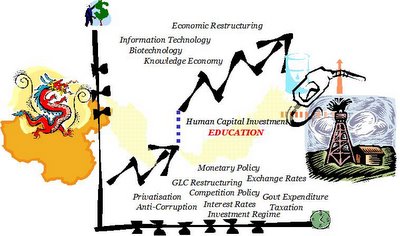
The diagram which I put up above probably summarises the entire gist of my presentation.
The Graph charts the growth path that Malaysian intends to pursue. For many years in the 1980s and early 1990s, Malaysia grew at a rapid rate of between 8-10% annually. Those would be the years that many businessmen will recall with fond memories. Unfortunately, by the time I started my own business, the boom years were a thing of the past.
Today, it appears that the structure of the Malaysian economy is only able to cater to growth in the region of 3-6%, with anything above 5%, we appear to be extremely thankful. Some of the tools that the government has to fine tune the 3-6% are highlighted in the bottom part of the chart. They include manipulating interest and exchange rates, the restructuring of government linked companies, tax and investment incentives etc.
On the left and right of the chart, you'll find the twin threats to the Malaysian economy as well as the largest factors keeping our growth rates capped at below 6%. First of all, we have China who have over the past decade emerged as the fastest growing economy in the world. As a result, China is sucking in all the foreign investments away from Southeast Asia - in manufacturing sectors from electronics to soft toys. Malaysia and Southeast Asia are no longer the "preferred" manufacturing base for foreign multinational companies.
On the right, you will have the sky-rocketing oil prices which may in the near term serve as an economic dampener to the global economy, which will in turn retard our growth. While the negative oil price impact on Malaysians will be negated somewhat from the fact that we are net exporters of oil, many other richer countries which dominate the global economy are not so lucky. As a result rising prices will result in a reduction of demand, particularly on electronic consumer goods. It's worth noting that manufacturing contributes to some 30% of the Malaysian economy, and the bulk of it is electrical manufacturing.
Hence the strategy of many nations like us today is really to diversify from industries in which China has an increasing (if not overwhelming) competitive advantage and focus on more intellectual property driven sectors. These "new" knowledge economy sectors as indicated in the top part of the chart, are meant to take Malaysia to the next level, hopefully a return to the glory days of 8-10% growth per annum, represented by the top arrow in the chart. You would have noted that the Malaysian government has "promoted" heavily in these "new economy" sectors such as information technology through the Multimedia Super Corridor and biotechnology through projects such as the BioValley and its corresponding tax and investment incentives.
However, try as hard as the government to promote these sectors, the rate of growth and development has been to date, a little disappointing. The underlying reason for the failure is extremely simple. While attempting to promote the "new economy", the regime is still pretty much focused on the "old economy" mechanisms. When Malaysia grew rapidly in the 1980s led by the manufacturing and industrial sectors, the key policies were to allocate land, provide pioneer and tax incentives, supply a pool of labour sufficiently literate to understanding assembly plant operations, and investors "flocked" to the country.
The same strategy appeared when Malaysia tried to move into the new economy. Promotions and incentives were given to geographically designated zones coupled with a liberalisation to import "knowledge workers" into the country.
What the government has failed to take into consideration really, and the real reason why these policies have not set the world alight, is simply "education". The knowledge economy is termed as such precisely because it relies almost entirely on top quality educated population. Practically everything else plays a supporting role. There is absolutely no short cut to the process. The "new economy", so to speak, is all about what's in the head, and not about competent workers operating machineries.
Only with the right amount, quality and level of education for the Malaysian population, can Malaysia hope to make the "jump" in growth rates from the unexciting 3-6% annually to anything above the 8% mark. Singapore is facing the same challenge as Malaysia in moving from a electronics-based manufacturing economy to a knowledge economy. However, their efforts, particularly in the biotechnology sector appears to be bearing fruits as the pharmaceutical based industries in Singapore helped pushed Singapore's growth rate last year to almost 7%, after "languishing" below 6% for a few years.
What's the difference in this case between Malaysia and Singapore? For me, it is in the difference between the educational institutions. This "education gap" is epitomised by the fact that the National University of Singapore (NUS) and the Nanyang Technological University (NTU) are both world-class institutions. For those interested in rankings, they are ranked 22nd and 48th respectively by the Times Higher Education Supplemnet (THES).
Probably more significantly, they are rated even higher for the new economy subjects, tecnology, science and biomedicine - which are critical inputs into the knowledge-based economy in the areas of information technology, high-end industrial design, biotechnology etc. Their rankings for these sectors are summarised below:
It appears quite obvious that Malaysia has decided to place greater importance of quantity over the need for quality. 3 universities serves the interest of the 4.4 million population in Singapore, while 38 similar institutions are serving the needs of Malaysia's 25.6 million. That means that Malaysia has more than double the relative ratios of universities. The ratio will only increase further as Malaysia has plans to add another public university in Kelantan soon and are upgrading more private colleges to "university college" status.
The fact that we have tens of thousand of unemployed graduates only serves to provide empirical evidence to the fact that we are over-producing degree graduates, the bulk of which do not meet the necessary standards to partake in the new economy. It was unsurprising that despite the shortage of labour to meet demand for computer engineers and programmers in the country, a large proportion of these unemployed graduates are actually from the computer science faculties of the local universities.
In the past, our manufacturing industries have been driven by "raw materials" which we have in abundance - land, commodities and affordable competent labour. The competitive advantage in these sectors have been eroded in the past years by "emerging" China and may one day, disappear altogether. However, despite the earnest in which the government is promoting the knowledge economy, we have not done enough to provide and supply the necessary "raw materials" for the new economy - a large enough and competent talent pool of graduates produced by top quality universities.
It is my humble opinion that, until the Malaysian government hardens its resolve to dramatically reform the education system from primary to tertiary in Malaysia to raise the quality output significantly, Malaysia's dreams of having the 'knowledge economy' to help boost growth in the country will not be achieved anywhere in the near future. I would call on the Government to spend the windfall income derived from the high and rising oil prices on improving the quality of education in Malaysia to leave an enduring legacy for the country. That is why, education is intrinsically and critically related to the future economy of Malaysia.
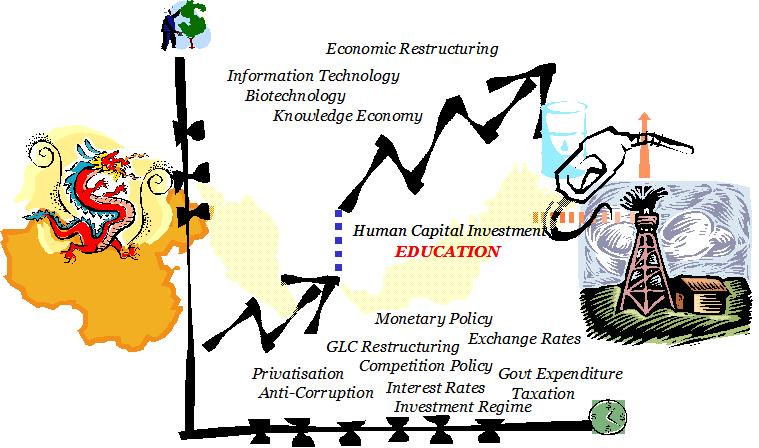
The diagram which I put up above probably summarises the entire gist of my presentation.
The Graph charts the growth path that Malaysian intends to pursue. For many years in the 1980s and early 1990s, Malaysia grew at a rapid rate of between 8-10% annually. Those would be the years that many businessmen will recall with fond memories. Unfortunately, by the time I started my own business, the boom years were a thing of the past.
Today, it appears that the structure of the Malaysian economy is only able to cater to growth in the region of 3-6%, with anything above 5%, we appear to be extremely thankful. Some of the tools that the government has to fine tune the 3-6% are highlighted in the bottom part of the chart. They include manipulating interest and exchange rates, the restructuring of government linked companies, tax and investment incentives etc.
On the left and right of the chart, you'll find the twin threats to the Malaysian economy as well as the largest factors keeping our growth rates capped at below 6%. First of all, we have China who have over the past decade emerged as the fastest growing economy in the world. As a result, China is sucking in all the foreign investments away from Southeast Asia - in manufacturing sectors from electronics to soft toys. Malaysia and Southeast Asia are no longer the "preferred" manufacturing base for foreign multinational companies.
On the right, you will have the sky-rocketing oil prices which may in the near term serve as an economic dampener to the global economy, which will in turn retard our growth. While the negative oil price impact on Malaysians will be negated somewhat from the fact that we are net exporters of oil, many other richer countries which dominate the global economy are not so lucky. As a result rising prices will result in a reduction of demand, particularly on electronic consumer goods. It's worth noting that manufacturing contributes to some 30% of the Malaysian economy, and the bulk of it is electrical manufacturing.
Hence the strategy of many nations like us today is really to diversify from industries in which China has an increasing (if not overwhelming) competitive advantage and focus on more intellectual property driven sectors. These "new" knowledge economy sectors as indicated in the top part of the chart, are meant to take Malaysia to the next level, hopefully a return to the glory days of 8-10% growth per annum, represented by the top arrow in the chart. You would have noted that the Malaysian government has "promoted" heavily in these "new economy" sectors such as information technology through the Multimedia Super Corridor and biotechnology through projects such as the BioValley and its corresponding tax and investment incentives.
However, try as hard as the government to promote these sectors, the rate of growth and development has been to date, a little disappointing. The underlying reason for the failure is extremely simple. While attempting to promote the "new economy", the regime is still pretty much focused on the "old economy" mechanisms. When Malaysia grew rapidly in the 1980s led by the manufacturing and industrial sectors, the key policies were to allocate land, provide pioneer and tax incentives, supply a pool of labour sufficiently literate to understanding assembly plant operations, and investors "flocked" to the country.
The same strategy appeared when Malaysia tried to move into the new economy. Promotions and incentives were given to geographically designated zones coupled with a liberalisation to import "knowledge workers" into the country.
What the government has failed to take into consideration really, and the real reason why these policies have not set the world alight, is simply "education". The knowledge economy is termed as such precisely because it relies almost entirely on top quality educated population. Practically everything else plays a supporting role. There is absolutely no short cut to the process. The "new economy", so to speak, is all about what's in the head, and not about competent workers operating machineries.
Only with the right amount, quality and level of education for the Malaysian population, can Malaysia hope to make the "jump" in growth rates from the unexciting 3-6% annually to anything above the 8% mark. Singapore is facing the same challenge as Malaysia in moving from a electronics-based manufacturing economy to a knowledge economy. However, their efforts, particularly in the biotechnology sector appears to be bearing fruits as the pharmaceutical based industries in Singapore helped pushed Singapore's growth rate last year to almost 7%, after "languishing" below 6% for a few years.
What's the difference in this case between Malaysia and Singapore? For me, it is in the difference between the educational institutions. This "education gap" is epitomised by the fact that the National University of Singapore (NUS) and the Nanyang Technological University (NTU) are both world-class institutions. For those interested in rankings, they are ranked 22nd and 48th respectively by the Times Higher Education Supplemnet (THES).
Probably more significantly, they are rated even higher for the new economy subjects, tecnology, science and biomedicine - which are critical inputs into the knowledge-based economy in the areas of information technology, high-end industrial design, biotechnology etc. Their rankings for these sectors are summarised below:
- Technology - NUS (9th) and NTU (26th)
- Science - NUS (34th) (There is no science faculty in NTU)
- Biomedicine - NUS (15th) (There is only a biological sciences school in NTU, no medicine faculty)
It appears quite obvious that Malaysia has decided to place greater importance of quantity over the need for quality. 3 universities serves the interest of the 4.4 million population in Singapore, while 38 similar institutions are serving the needs of Malaysia's 25.6 million. That means that Malaysia has more than double the relative ratios of universities. The ratio will only increase further as Malaysia has plans to add another public university in Kelantan soon and are upgrading more private colleges to "university college" status.
The fact that we have tens of thousand of unemployed graduates only serves to provide empirical evidence to the fact that we are over-producing degree graduates, the bulk of which do not meet the necessary standards to partake in the new economy. It was unsurprising that despite the shortage of labour to meet demand for computer engineers and programmers in the country, a large proportion of these unemployed graduates are actually from the computer science faculties of the local universities.
In the past, our manufacturing industries have been driven by "raw materials" which we have in abundance - land, commodities and affordable competent labour. The competitive advantage in these sectors have been eroded in the past years by "emerging" China and may one day, disappear altogether. However, despite the earnest in which the government is promoting the knowledge economy, we have not done enough to provide and supply the necessary "raw materials" for the new economy - a large enough and competent talent pool of graduates produced by top quality universities.
It is my humble opinion that, until the Malaysian government hardens its resolve to dramatically reform the education system from primary to tertiary in Malaysia to raise the quality output significantly, Malaysia's dreams of having the 'knowledge economy' to help boost growth in the country will not be achieved anywhere in the near future. I would call on the Government to spend the windfall income derived from the high and rising oil prices on improving the quality of education in Malaysia to leave an enduring legacy for the country. That is why, education is intrinsically and critically related to the future economy of Malaysia.
Thursday, January 19, 2006
More Creative Degrees
 Before this post gets taken as an advertisement for LimKokWing University College of Creative Technology (LUCCT), let me emphasize that it is not the case. But I must compliment the school administrators for living up to their "creative" name by coming up with some of the most "creative" degree programmes to attract the possibly still naive and blurry eyed Form Five students.
However is this creativity to come up with the hip-sounding degree programmes really a good thing for the prospective students? This is not the first time I've written about LUCCT's creative advertising programmes. Check out "Mindpower is more Powderful" and "Unmatched * Unequalled * Unrivalled". I suppose, I've picked on their advertisements to write about more frequently than other private colleges (who are often equally guilty in creative advertising) is because LUCCT probably spends the most in media advertising, and their ads are indeed while not graphically creative, are content-wise most "creative".
Having Bachelor's Degrees in subjects such as Mobile Computing, Animation, Event Management sounds exciting on first glance, and certainly gives the impression of being "innovative". While there is definitely a demand for candidates with skills in mobile computing, animation etc. as per the "appropriately" named degree programmes, I have grave reservations as to whether such niche programmes should be a "degree" programmes in the first place.
Should we for example, have a degree in "Word Processing" or "Financial Spreadsheet Management" or for that matter "Secretaryship" just because these skills are "in demand" in the marketplace? I've written some eight months back with regards with graduates with "Neither Here Nor There Degrees", would the above be such degrees?
If I'm a graduate with an Animation degree, what are my job prospects in the market? What will be the growth and career path which I am able to take over a period of 10-20 years? For that matter, how much is an "animator" paid in the market and what's the typical market increment like annually?
With a degree in such a specialised subject such as Animation, am I not limiting myself in terms of career and personal growth prospects? Will I remain an animator for the rest of my life?
I have no disrespect to animators, and I'm certain that there are well-paid animators in the market. My concern is, should degree programmes be this specialised and so focused on skills, instead of focusing on broader aspects such as critical thinking, analytical skills etc.? After completing a more all-rounded degree programme, then the candidates may choose a more specialised occupation as "animators", and they will be better employees as a result.
Shouldn't for example, mobile computing be a topic or subject within a degree programme for Computer Science instead of being a degree on its own?
The larger underlying question for both the students and authorities to ponder over is what is the role of a university, as opposed to more skills based institutions such as polytechnics. It is my core belief that polytechnics and institutes should be focusing more on skills such as "industrial design" or "secretaryship" and issuing diplomas (or certificates) for the relevant subjects. Universities instead should focus on broader subjects which exposes students to a wider variety of topics, which in turn tests the candidates for their critical thinking and analytical skills. A degree in say, "Animation" does not do that. I'm not sure what do students actually learn for 3 years of "Animation" for the degree.
In my previous post with regards to neither here nor there degree programmes, I gave the example of a degree programme in multimedia design and technology. The bulk of the course work is unfortunately focused on utilising software applications available in the market like Adobe Photoshop, Macromedia Authorware, Flash and Fireworks, and a mix of user-interface development tools such as Dreamweaver or Frontpage etc. If you ask me if these skills are useful, I'd definitely say "yes".
But if you ask me whether these tools are difficult to pick up, whether they should be taught as part of a degree programme, I'd give a definitive "no" as the answer. The only difference between Photoshop and a Wordprocessor like Microsoft Word is one deals with images, while the other deals with word documents. Should we be having examinations contributing to the students' overall CGPA for Microsoft Word? No!
Such tools are incidental to the subject which is being taught and students should be expected to pick up those skills on their own as part of projects submission or as a "Certificate" programme.
So, prospective students of tertiary education out there really need to keep their eyes wide open with regards to the fancy degree programmes. Unfortunately, our higher education authorities do not possess the necessary competency to differentiate between the quality of courses to regulate the industry in the required fashion. Hence, as a result,
it is pretty much left to the students themselves to differentiate the real stuff from the hype to prevent enrolment into a wrong course (or institution), possibly putting waste a valuable 3 years of one's life in education.
Wednesday, January 18, 2006
In Pursuit of Degrees...
The Sunday Star two weeks ago had a very well written commentary piece with regards to the pursuit of education and degrees. These are definitely words to remember for anyone intending to take education for what it should be instead of the "corrupted" version many in our society take it for.
On education fairs and marketing hype:
On education fairs and marketing hype:
Education fairs and college open houses are in season and it is hard sometimes to distinguish a real deal from a sales pitch.Of Degrees & Employment:
Tertiary education is no longer the preserve of the select few. There are many options available at home and abroad. The majority of those seeking a degree are mindful of the vocational pursuits available to them once they graduate.On Critical Thinking & other soft skills:
But, as recent trends have shown, a degree is not necessarily a passport to a better job. With a bigger pool to choose from, employers can be more selective. Soft skills become a premium. A first class honours without the all-round skills will definitely not put you at the top of the career shortlist.
Interact with your lecturers. Challenge their viewpoints. Broaden your horizons. Throw in all the extra-curricular activities and you will be able to hone those skills that are very much in demand in the real world.On Parents:
... parents must encourage their children to make full use of their potential and take on their pursuit of education with renewed zeal. Otherwise, all they will have after this journey is nothing more than a piece of paper.Take heed.
Tuesday, January 17, 2006
All Schools Are Not Created Equal
According to the Director-General of Ministry of Education, Datuk Ahmad Sipon, there is absolutely no difference between attending a neighbourhood school as opposed to schools in urban centres. Hence, parents should not attempt to register "children only in schools with a good reputation results in overcrowding at these schools and could adversely affect the learning environment".
It is in fact better for the parents, as the key consideration should be that "you will not have to waste time sending your children to school." Other considerations are secondary.
What's more, "all schools had the same facilities and the ministry had worked to ensure they all had good teachers. Therefore, every school was a good school..."
Who is the Director-General trying to kid? Aizuddin Danian, unsurprisingly, described the above statements as "bullsh*t".
However, entry was not straightforward as the officials tend to allocate students to schools closer to home, especially when Montfort is extremely popular amongst parents. The only assured way of enrolling into Standard One, and be assigned to the top class at Montfort is if you are a graduate from the privately run kindergarten at Montfort which takes in only some 30+ students.
Hence, my dad tried to register me at the kindergarten before the registration period and got turned away. He tried to register me when the registration opened and got asked to return another day. And when he returned on the specified day, he was informed that registration was closed as all the seats were taken up. Knowing that the headmaster of the school has a tendency to register only children from well-to-do families or those whose parents are teachers, my dad got extremely upset with him. I can only assume that my dad, being twice Mr Malaysia and once Mr Asia in bodybuilding, managed to convince the headmaster that I should be given a place in the kindergarten :-)
And here I am today. To cut a long story short, if not for the fact that my dad managed to enrol me into the premier school in town, I definitely would not have received the Asean scholarship to study in the top school in Singapore, which then led to the opportunity to pursue my education at Oxford.
I was not the only one. My best friend in primary school was the son of a retired locksmith who lived in a squatter zone. He took exactly the same route (except he went to Singapore at a later stage) and ended up in the same college as me in the United Kingdom. He is now the Country Managing Director for Singapore's premier shipping company in Vietnam.
Unlike many who were born to educated parents, we had only our teachers in school to rely on in education as our parents were not able to assist us with my homework (etc. etc.) besides providing us with moral support. I"m not sure about this friend of mine, as he's definitely the smarter one, but had I been enrolled into my neighbourhood schools, I am dead certain that I'll not have achieved as much today. All schools are definitely not created equal.
It is in fact better for the parents, as the key consideration should be that "you will not have to waste time sending your children to school." Other considerations are secondary.
What's more, "all schools had the same facilities and the ministry had worked to ensure they all had good teachers. Therefore, every school was a good school..."
Who is the Director-General trying to kid? Aizuddin Danian, unsurprisingly, described the above statements as "bullsh*t".
Have you seen the quality of some schools in elite areas such as Sri Hartamas, Bukit Damansara and Taman Tun Dr Ismail? They are freakin' amazing. My alma mater in Bukit Damansara has a state of the art running track, a meticulously cared for lawn, and an air-conditioned hall... Schools are not all the same. Datuk Ahmad is lying or terribly misinformed.Let me give you a little bit of my personal experience. My kampung in Batu Pahat, along the Tanjong Labuh-Koris Road is some 15 kilometres from the town centre. There are at least 2 neighbourhood schools which are probably within a 5 kilometre radius from my home. My dad, who only completed 2-3 years of formal education, decided that the school that I should attend is the top national-type primary school in Batu Pahat right in the middle of town, Montfort Boys Primary School.
However, entry was not straightforward as the officials tend to allocate students to schools closer to home, especially when Montfort is extremely popular amongst parents. The only assured way of enrolling into Standard One, and be assigned to the top class at Montfort is if you are a graduate from the privately run kindergarten at Montfort which takes in only some 30+ students.
Hence, my dad tried to register me at the kindergarten before the registration period and got turned away. He tried to register me when the registration opened and got asked to return another day. And when he returned on the specified day, he was informed that registration was closed as all the seats were taken up. Knowing that the headmaster of the school has a tendency to register only children from well-to-do families or those whose parents are teachers, my dad got extremely upset with him. I can only assume that my dad, being twice Mr Malaysia and once Mr Asia in bodybuilding, managed to convince the headmaster that I should be given a place in the kindergarten :-)
And here I am today. To cut a long story short, if not for the fact that my dad managed to enrol me into the premier school in town, I definitely would not have received the Asean scholarship to study in the top school in Singapore, which then led to the opportunity to pursue my education at Oxford.
I was not the only one. My best friend in primary school was the son of a retired locksmith who lived in a squatter zone. He took exactly the same route (except he went to Singapore at a later stage) and ended up in the same college as me in the United Kingdom. He is now the Country Managing Director for Singapore's premier shipping company in Vietnam.
Unlike many who were born to educated parents, we had only our teachers in school to rely on in education as our parents were not able to assist us with my homework (etc. etc.) besides providing us with moral support. I"m not sure about this friend of mine, as he's definitely the smarter one, but had I been enrolled into my neighbourhood schools, I am dead certain that I'll not have achieved as much today. All schools are definitely not created equal.
Subscribe to:
Posts (Atom)